

By Ellie-Rose Davies, Content Manager at IMRG
Conversion rates have fallen to a 25-year low, according to IMRG’s Online Retail Index. In this blog, we explore what’s driving the decline, what it means for online trading, and share expert insight on how retailers can adapt their strategies to improve conversion performance in the months ahead.
IMRG Conversion Rate data
In April, (specifically the w/c 5th) we reported the lowest Conversion Rate* tracked for the total online market since the year 2000, at 2.7%.
*Defined as the percentage of visitors who complete a purchase on retail sites.
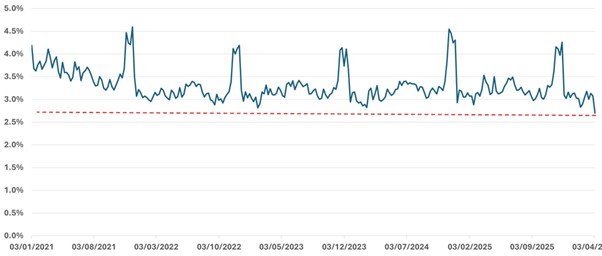
Source: IMRG’s Online Retail Index
As noted by our Strategy & Insight Director, Andy Mulcahy, ‘We didn’t see this low of a rate during the energy shock in 2022 when inflation hit 11%.’
Geopolitical conflicts could well be impacting customer confidence, and Andy reflected on how ‘It may also be exacerbated by the volumes of bot traffic retailers have been seeing over the past few months.’
Garret Cunningham, VP of CX at Columbus Global, agrees that consumers are becoming increasingly cautious with discretionary spending.
He says, ‘We are seeing conversion rates hit in retail as consumers are feeling the pressure more and more from a combination of cost of living increases as well as geopolitical factors affecting consumer confidence.’
‘Every day consumers are facing the news of ongoing enlist in the Middle East which always feels at risk of escalating driving further increases in fuel costs and energy costs. While things risk hangs over users, they are being more careful with their spend and spending less on nice to haves, saving their money for the necessities.’
Garret also notes the impact current travel concerns may be having on consumer spending:
‘As the summer holidays loom, costumers are also now facing regular news stories preparing them for increased costs of flights and potential fuel surcharges. Regardless of whether or not this comes a reality, it builds on the fear of rising costs for consumers, and they are saving their money in readiness for unexpected expenses.’
Another key point is that Google’s March 2026 Core Update is penalising AI-heavy content, pushing pages with highly AI-generated copy further down in search rankings. This could be having a direct impact on conversion rates as retailers are not appearing so highly in prospective customers’ feeds.
With this, retailers may benefit from taking a more human-led approach to their product pages, prioritising authenticity as the year progresses.
Andy did some research on how conversion rates compare for premium retailers across the same timeframe. Interestingly, it showed that 2026 has been ‘competitively low for conversion’ for all tiers, ‘but the pattern is most pronounced for premium retailers.’
As shown in the chart below, there is a significant downward trend for conversion for premium retailers since 2021.
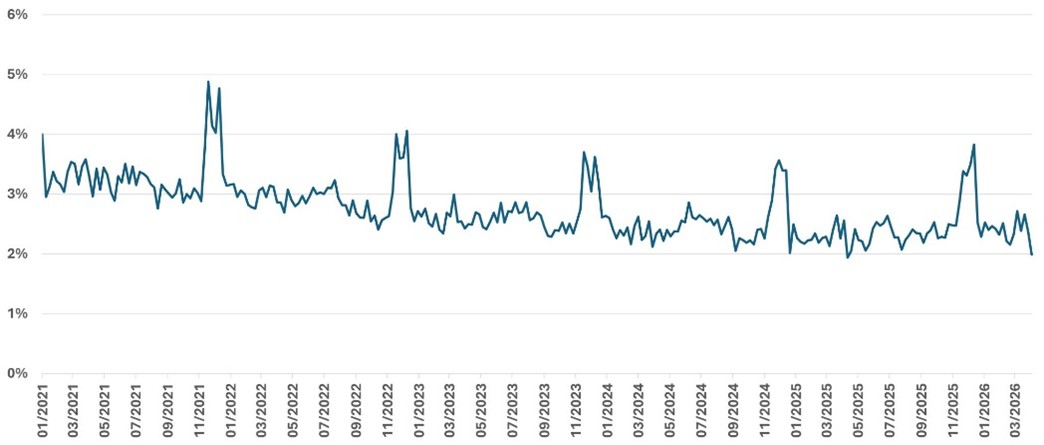
Source: IMRG’s Online Retail Index
To gain product category specific data, visit our Digital Dashboard where you can spot differences and see how you compare.
Data quality and smarter optimisation strategies
For retailers looking to protect performance in the months ahead, data quality and optimisation are becoming increasingly important.
Chloe Humphrys, Performance Manager at Shoptimised, echoes the points made around changing consumer behaviour and increased caution around spending.
‘Consumers are becoming more cost-conscious and buying smarter, leading to greater competition and a longer decision cycle. We’ve also seen a degree of hold-off in spending over the past couple of months. It is not enough to cause major concern, but it is enough to justify a smarter approach.’
She added that while retailers may be seeing slower conversion performance, there are still clear opportunities to protect momentum and improve results through smarter optimisation and planning.
‘If retailers are seeing a slowdown, the focus should be on protecting momentum while reassessing budget plans. Some spend planned for this quarter may work harder later in Q3 or Q4, when these pressures may have eased, and returns may be stronger. Product feed optimisation can also help improve traffic quality, reduce wasted spend, minimise bounce rate, and give conversion rates a better chance to improve.’
As the rest of this blog explores, retailers are now navigating a combination of economic uncertainty, changing customer expectations and AI-driven shifts in traffic and discovery, making optimisation across the entire customer journey more important than ever.
Is AI changing what conversion rates really mean?
While economic uncertainty is undoubtedly impacting shopper confidence, experts suggest AI is also beginning to distort how conversion performance should be interpreted.
On one side, AI-powered shopping agents and discovery tools are increasing site traffic without always bringing genuine purchase intent, making conversion rates appear weaker.
On the other, retailers are now competing in AI-driven search and recommendation environments where poor product data, inconsistent content and checkout friction can directly impact visibility and sales.
Kevin Griffin, VP Growth at PXP, believes AI is making visitor numbers less reliable as a measure of true demand:
‘The 2.7% conversion rate reflects macro pressure, but it’s also exposing structural problems that predate the current uncertainty. The visitor count itself is increasingly unreliable: AI shopping agents inflate visit numbers without genuine purchase intent behind every session, distorting the baseline’
Kevin also highlights that for shoppers who do arrive with intent, retailers are still losing sales through avoidable checkout issues –
‘Missing payment methods, blunt fraud controls generating false declines, and authentication flows that challenge everyone rather than assess actual risk are all avoidable losses.’
‘Retailers who tighten their checkout infrastructure now, and build for agentic commerce alongside human shoppers, will be best placed when confidence returns,’ says Kevin.
Justin Thomas, VP Sales, EMEA North at Akeneo, added that AI is also changing how consumers discover products online.
He shares, ‘Consumers are increasingly discovering products through AI-generated recommendations, social search and conversational interfaces before they ever reach a retailer’s site.’
This means retailers are increasingly dependent on the quality and structure of their product data to remain visible within AI-powered discovery channels.
Justin exclaims, ‘That means retailers are receiving lower-intent traffic while also competing in environments where poor or inconsistent product data gets filtered out by AI systems.’
To help improve conversion in the coming months, Justin recommends that retailers ‘product information as a strategic asset: structured, trusted and optimised not just for humans, but for AI agents making recommendations on behalf of consumers. In the agentic era, discoverability and trust become inseparable.’
Reducing friction across the customer journey
Beyond economic pressures and AI-driven traffic changes, many experts agree that retailers still have significant opportunities to improve conversion through customer experience optimisation.
Rory O’Connor, Founder and CEO at Scurri, believes customer expectations around fulfilment and delivery are increasingly shaping purchase decisions.
‘Conversion pressure reflects a wider shift in consumer behaviour. Shoppers are more cautious, but they are also far less tolerant of uncertainty after purchase. Delivery promises, returns transparency and confidence in fulfilment now influence purchasing decisions earlier in the journey, particularly as consumers increasingly use AI tools and marketplaces to compare options instantly.’
Rory adds, ‘Retailers cannot treat the post-purchase experience as operational plumbing anymore. In the months ahead, the strongest performers will be those that reduce friction across the entire customer journey, from checkout through to delivery and returns, while using delivery data more intelligently to personalise experiences and build trust.’
fulfilmentcrowd also highlight how fulfilment consistency and operational visibility are becoming increasingly important as customer expectations rise:
‘Lower conversion rates reflect a confidence gap in eCommerce. Customers are spending more cautiously for a multitude of reasons, while expectations around delivery, returns and convenience remain high.’
They say, ‘The challenge for retailers is to maintain high service levels across increasingly complex, multi-channel operations; when stock visibility, delivery performance, returns processes and post-purchase experiences differ by channel, customers quickly feel it.’
Garret Cunningham, VP of CX at Columbus Global, also reflects on the importance of building trust and urgency throughout the purchase process:
‘Our advice to brands trying to combat the drop in conversion rate is to ensure you have a compelling reason for the consumer to choose you.’
‘Appeal to their needs and the reason why buying from you is better than the alternative pod either not purchasing at all, or going for a budget option,’ says Garret.
He tells us that reassurance and transparency remain critical.
‘Reassurance of delivery timings, will satisfy users with a need for urgency, customer satisfaction and reviews act as great social proof to reassure users that they will be happy with the product when they receive it, removing any guess work about sizing, fit and quality, and utilise scarcity or urgency to drive the purchase now.’
‘This may not be about low stock; it could be about seasonality and stock rotation. Delaying the purchase may mean missing out if it’s no longer available.’
Data quality and operational optimisation
As retailers look for ways to improve conversion performance, reducing friction and improving customer experience are becoming increasingly important.
Barley Laing, the UK Managing Director at Melissa, argues that in today’s climate, retailers that ‘standout by delivering a seamless customer experience, not only in the online purchasing journey, but also with speedy fulfilment and delivery’ are best placed to succeed.
He also highlights the importance of accurate customer data and reducing friction throughout the customer journey.
‘To achieve this requires accurate customer data and removing points of friction throughout the online customer journey. To seamlessly and accurately collect customer data, particularly address data at the onboarding stage, consider using an address lookup or autocomplete service.’
Barley explains that improving onboarding and checkout experiences can help enhance the overall customer experience while increasing the likelihood of completed purchases.
‘These tools reduce the number of keystrokes required by up to 81 per cent when inputting an address by highlighting the correctly formatted address as the user starts inputting theirs. As a result, the onboarding process is speeded up, enhancing the entire customer experience, making it more likely that a purchase will be completed.’
He adds that delivery performance and accurate customer data also play a key role in customer retention.
‘Failed deliveries not only cost retailers monetarily, but also their reputation. In fact, according to research by Ipsos 85 per cent of online shoppers said a poor delivery experience would prevent them from ordering from that retailer again.’
In summary
While wider economic pressures are clearly impacting shopper confidence, the decline in conversion rates also reflects broader shifts in online retail, from AI-driven discovery and changing customer expectations to increasing pressure on fulfilment, checkout experience and product data quality.
For retailers, improving conversion in the months ahead may rely less on driving higher volumes of traffic, and more on reducing friction, building trust and creating seamless experiences across the entire customer journey.
Published 27/05/2026
