

By Ellie-Rose Davies, Content Manager at IMRG
In this blog we look at healthy ways to improve average basket values in 2026 with the help of our community of industry experts.
Read on to discover:
- Industry ABV insights
- Driving higher basket value through acquisition channels
- Start earlier: influence basket value before checkout
- Relevance, personalisation and timing are key
- AI, data and technology as growth levers
- Bundling and ‘complete the set’ thinking
- Delivery thresholds and incentives that drive action
Industry ABV insights
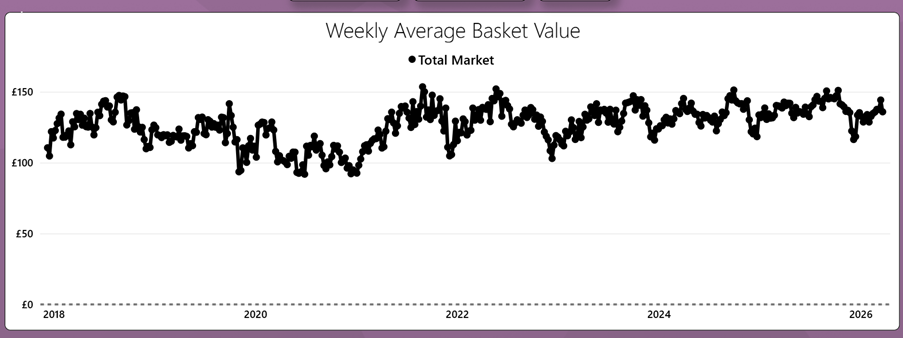
Source: IMRG’s Online Retail Index, Digital Dashboard
IMRG data shows growth in online average basket value (ABV) from 2020 onwards, rising from a pre-pandemic baseline of £110–£130 to a sustained range of £130–£150 in recent years.
Initially driven by COVID-19 behaviours, for example, fewer, larger transactions and increased spend across grocery, home, and electricals, this uplift has persisted due to wider contextual factors.
Inflation has played a key role, with rising costs pushing up prices, while retailers have further supported growth through tactics such as higher delivery thresholds, promotional mechanics, and improved cross-sell and bundling.
Read on to hear from experts on how retailers can continue to grow ABV beyond price-led increases, particularly as inflation and rising delivery costs persists.
Driving higher basket value through acquisition channels
Average basket value can be influenced before the customer visits a retailers’ site, with acquisition strategies playing a key role in setting expectations around spend.
Joe Appleton, Head of Performance at Shoptimised says, ‘From Google Ads, ABV rises when the feed helps you bid for value. Retailers can use pricing or custom labels to separate higher priced items, then weight budget towards them.’
‘Expect higher CPCs and lower CVR, so retailers can keep search terms tight and watch CTR and price competitiveness.’
Joe recommends retailers to ‘Use Merchant Center promotions for free shipping thresholds or minimum spend codes so the offer shows on the ad before the click.’
‘If you have bought together data, build Smart Bundling kits in the feed and advertise them. Add negatives like cheap, used and discount. On site, progress bars and behaviour routing support bigger baskets.’
Start earlier: influence basket value before checkout
There are numerous ways to grow ABV ahead of the checkout stage, enabling retailers to prompt profits much earlier in the purchasing journey.
Dan Bond, VP of Marketing at RevLifter reflects on this, saying ‘Most basket value tactics focus on the cart. That’s too late. The real opportunity is earlier: catch shoppers while they’re still browsing and still open to adding more.’
‘Progress bars can work because they make a goal visible. Cross-sell tends to work best when it’s based on what’s actually in the basket, not a generic “you might also like.” Bundling works when the savings feel real, not manufactured.’
Dan exclaims, ‘What unites the approaches that actually move the needle is intent. Show the offer to someone already heading for the exit, and you’ve probably wasted it. Show it to someone mid-browse with three items and an open mind, and you’ve got a genuine opportunity to increase AOV.’
Similarly, Kevin Griffin, VP Growth at PXP reveals ‘Growing average basket value isn’t just a merchandising challenge; it starts long before checkout.’
‘Progress bars, bundles, and smart recommendations all nudge customers to spend more, but retailers often overlook the role payments play.’
Once customers get to the checkout ‘Offering flexible payment methods, including Buy Now Pay Later, removes the psychological ceiling on spend.’
‘A seamless, fast checkout with saved cards, one-click purchase, and preferred local payment methods means customers are less likely to edit their basket down before completing.’
Kevin shares that ‘The retailers seeing the strongest ABV gains are those treating the entire journey, right through to payment, as one connected conversion opportunity.’
Relevance, personalisation and timing are key
Prompting growth in ABV can be best fulfilled through making the customer experience timely and hyper-relevant.
Hem Nathwani, Sales Director, at Price Trakker explores this, stating ‘Improving average basket value in 2026 is less about pushing more products and more about relevance and timing.’
‘Effective strategies retailers can implement use data to present the right offer at the right moment, such as intelligent bundling, personalised recommendations and threshold-based incentives like free delivery.’
Hem says, ‘Retailers seeing the best results tend to be those who test and refine continuously, using competitor and pricing insights to stay competitive while maximising margin.’
‘Small changes in positioning or pricing can significantly influence basket size. The key is combining behavioural insights with real time data to create a seamless and persuasive shopping experience.’
Nate Barad, Vice President of Technical and Product Marketing at Algolia, reveals how AI is making hyper-relevancy possible; ‘Agentic and generative AI are redefining how retailers grow basket value by acting on customer intent, not just suggesting products.’
Retailers can use AI to ‘dynamically build bundles, personalise upsell paths in real time, and guide shoppers conversationally using context, preferences, and journey stage.’
Nate reflects on the value of it, where ‘Rather than relying on static rules, it interprets whether a shopper is browsing, comparing, or ready to buy, and adapts instantly.’
‘The result is higher conversion and larger baskets without added friction. When AI understands intent, it becomes a trusted guide, helping customers discover and add what they truly want.’
AI, data and technology as growth levers
Considering the role of AI in growing ABV further, we spoke with Jessica Buckley, Technology Partner Consultant at Awin.
She shares how retailers are ‘deploying AI‑powered engines across key customer touchpoints to increase ABV.
‘Dynamic minicarts have shown to deliver strong performance, generating a 12–18% lift in conversion by surfacing real‑time, behaviour‑driven product suggestions to customers within the existing cart experience, effectively increasing units per transaction.’
Jessica notes how ‘One of the most effective ways to increase ABV is through advanced algorithms that learn over time, improving product selection and enabling AI‑driven product bundling strategies.;
‘Across partnerships, we’ve seen these optimisation models increase average basket value by 12%, demonstrating measurable commercial impact.’
‘Retailers can also boost average basket value by targeting lower-spending customers, using personalised banking offers to incentivise incremental spend above thresholds.’
Bundling and ‘complete the set’ thinking
With the help of AI, bundling is becoming more advanced, where the focus is more on growing baskets naturally.
Lewis Husbands, Client Success Specialist at ShoppingIQ says, ‘We’re seeing that the healthiest ABV growth in 2026 comes from being helpful, not pushy.’
‘Across our 50+ global partners, the most successful retailers have moved from simple upselling to solution-based selling. By using interdependent bundling and ‘complete the set’ logic, you can tap into the shopper’s natural desire for completion.’
Lewis shares that ‘When a customer is buying for a life stage, a home project, or an important moment they aren’t looking for extras but to be prepared.’
‘Positioning high-value bundles at the top of the page establishes a quality anchor, while non-intrusive ‘pop-asides’ can suggest relevant additions without breaking the journey’s flow.’
‘Whether it’s a smart delivery threshold or a one-click multi-buy, the goal is to make a larger basket feel like the most logical path to a finished result’, explains Lewis.
Romain Fouache, CEO at Akeneo echoes the importance of smart bundling but adds how the product information and pages need to be fully optimised.
He says, ‘Growing average basket value in 2026 will rely on to confidence to recommend complementary items that genuinely fit the shopper’s intent, and this depends on product information that is rich, consistent and contextualised.’
‘An effective approach is to combine AI-driven recommendations, intelligent bundling and incentives at the checkout (e.g. free delivery) with high-quality product data.’
‘Retailers are also optimising product detail pages PDPs with complete attributes, imagery and use cases to encourage add-ons. The result is higher conversion on recommendations, fewer returns and larger baskets,’ reveals Romain.
Further supporting bundling items are expert fulfilmentcrowd who state, ‘Flexible fulfilment capabilities – such as dynamic bundling and multi-item order handling – allow retailers to confidently promote product combinations or add-ons without introducing operational complexity.’
‘When fulfilment can support varied order profiles and bundling discounts, retailers can be more creative with merchandising and incentives.’
fulfilmentcrowd reveals, ‘We’re seeing leading brands successfully increase item-per-order volumes with this kind of bundling support; technology and warehouse processes actively contribute to this success, and it’s this kind of operational capability that gives customers more flexibility during their online shopping experience.’
Delivery thresholds and incentives that drive action
Delivery remains one of the most powerful and immediate levers retailers can use to influence basket behaviour at the point of purchase.
Gavin Murphy, Chief Marketing Officer at Scurri expresses that ‘One of the most effective and customer-friendly ways to grow average basket value is through delivery incentives at checkout.’
‘Clear thresholds such as ‘free delivery when you spend £x more’ give shoppers a simple, transparent reason to add an additional item to their basket.’
Gavin says, ‘We consistently see retailers use dynamic checkout messaging or progress bars to show customers how close they are to qualifying, which can significantly increase basket value without relying on heavy discounting.’
‘Crucially, delivery options also influence repeat purchasing. When retailers combine attractive delivery choices with reliable post-purchase communications and easy returns, they create an experience customers trust, making them far more likely to come back.’
In summary
To help drive sustainable ABV growth in 2026, retailers can focus on influencing spend early through acquisition and on-site journey design, using data and AI to deliver timely, relevant recommendations, and leveraging tactics such as bundling, delivery thresholds, and seamless checkout.
The key is to make adding more to basket feel intuitive, guiding customers towards higher-value purchases rather than making it feel forced.
Want to read more? Here are some recent IMRG blogs that may take your interest:
After the click: Current expectations around delivery and returns – IMRG
Building customer confidence throughout the purchasing funnel – IMRG
Fashion and Beauty eCommerce trends for 2026 – IMRG
Expectations for online trading in 2026 – IMRG
Published 07/04/26
