

By Ellie-Rose Davies, Content Manager at IMRG
The British weather may be predictably unpredictable, but one thing is certain: it has a habit of reshaping consumer demand overnight.
This summer has already brought soaring temperatures, heavy downpours and everything in between, creating peaks and troughs for some retailers.
While some businesses have capitalised on surging demand, others have been left scrambling to keep up.
So, how can retailers turn Britain’s ever-changing forecast into a commercial advantage? We asked industry experts to share their insights – but first, let’s look at the data.
The great heatwaves of 2026 so far
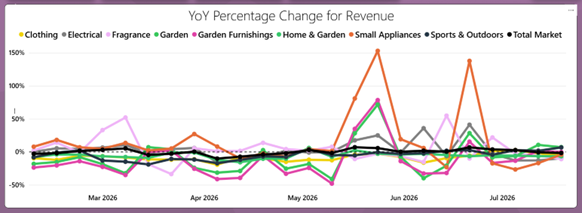
Source: IMRG’s Online Retail Index, Digital Dashboard 2026
We’ve had particularly hot weather throughout May-July this year, which brought notable upticks in online product categories such as small appliances, which saw astonishing growth in w/c 24th May at +153% YoY (Year-on-Year) and w/c 21st June, at +137.7% YoY.
With multiple days hitting above 30°C and record heat recorded on 26th June, it is no wonder that consumers began to invest in appliances such as fans. After weeks of heat and forecasts of further heatwaves, we can understand why consumers turned to weather-oriented product categories.
Other categories that have seen good performance include fragrance, which has often outperformed the total market, suggesting consumers have been investing in smelling nice in the warmer weather. We’ve also seen peaks in gardening, as people tried to save their struggling plants.
In the words of country legend Luke Combs, “When it rains it pours.” We’ve also seen some downpours this year and retailers can get ready to adapt quickly as consumer demand shifts.
Industry experts have shared where the biggest opportunities lie.
Spot changing consumer trends before they peak
The weather doesn’t just influence what people buy; it changes how they spend their time, where they shop and what they prioritise. While cooling products are an obvious winner during a heatwave, changing consumer behaviour often creates opportunities in unexpected categories too.
Jessica Elliott-Kim, Retail & Travel Partner at Awin notes how ‘While the surge in cooling devices has been expected, one of the more surprising trends has been consumers investing in creating their own sanctuaries at home.’
‘Rather than seeking out air-conditioned spaces, our data points to people spending on garden furniture, at-home dining and video games that help them make the most of home.’
‘From an affiliate perspective, retailers that brief upper-funnel partners on seasonal messaging ahead of forecasted heatwaves will have a competitive advantage, with relevant content already reaching consumers as demand starts to build,’ says Jessica.
Jessica reveals that ‘Unsurprisingly, it’s often the slightly less sexy areas of finance and telecoms that struggle during the heat but really shine during storms.’
‘During January’s named storms, for example, we saw both sectors outperform non-storm days as consumer priorities shifted.’
‘When demand shifts unexpectedly, speed becomes the competitive advantage. From an affiliate perspective, having quick activators that you can turn on when a storm catches you by surprise allows retailers to react immediately.’
Jessica shares how ‘Combined with customisable on-site experiences, such as weather-based product recommendations, retailers can stay relevant as consumer needs change.’
Use the weather to power smarter marketing
Reacting to the weather isn’t simply about increasing budgets when the sun comes out. Retailers that prepare campaigns in advance, structure their product feeds effectively and make promotional decisions based on changing demand are better placed to capture sales while protecting profitability.
Sophie Waugh, Performance Manager at Shoptimised shares how ‘UK seasons are notoriously unpredictable, making peak periods a moving target for weather-dependent sites.’
‘Take our raincoat client: comparing 2026’s wettest weekend (06/02–09/02) to its warmest (26/06–29/06), sunshine caused CPC to rise +45.16%, while clicks plummeted -80.60%.’
‘By anticipating these shifts, we slashed budgets by -71.84% and still maintained a ROAS above 1,100%, just a 1.45% variance from the rainy weekend.’
Sophie says ‘Preparation is key. Populating Custom Labels with seasonal data gives retailers a quicker way to react when the weather changes, whether that means campaign breakouts, listing exclusions or weather-specific performance rules.’
‘For example, a rule can tag products containing terms such as “summer”, “beach” or “swim” as “summer”, making it easier to separate seasonal products and adjust activity when demand shifts,’ exclaims Sophie.
While preparation lays the foundations, retailers also need to think carefully about how they respond. Promotional activity should be just as targeted as it is timely, ensuring demand is captured without unnecessarily sacrificing margin.
Dan Bond, VP of Marketing at RevLifter reinforces this, explaining that ‘British weather is unpredictable, so treating it as a single challenge or opportunity misses the point. It’s operational as much as commercial.’
‘A sudden heatwave can strand summer stock or empty it overnight, and retailers who can shift promotions by category, not sitewide, adapt fastest.’
‘The mistake is using weather as an excuse for wide discounting when a small nudge to the right shoppers would suffice. Good promotional strategy treats weather like any other demand shift: read it, react to it, but don’t let it dictate margin across the board,’ says Dan.
Respond faster than your competitors
Even the most accurate weather forecast is only valuable if retailers can act on it. When temperatures shift with little warning, speed becomes one of the biggest competitive advantages.
Kevin Steward, UK Country Head at Base.com reveals that ‘The British weather has always influenced buying behaviour, but today’s retailers have far more data and technology at their disposal to respond.’
‘At Base.com, we regularly see merchants adapting to sudden spikes in demand, whether that’s for cooling products during a heatwave or outdoor essentials after heavy rain.’
‘The challenge isn’t identifying the opportunity – it’s updating stock, pricing and product listings quickly across every sales channel. Retailers with connected systems and automated workflows can react much faster, helping them maximise sales while avoiding overselling or operational disruption when demand changes unexpectedly.’
Having connected systems is only part of the equation. Retailers also need complete visibility across inventory and sales channels to react before opportunities are missed.
Alexander Otto, Head of Creative Marketing & Events at Tradebyte argues that the ‘Weather doesn’t just influence what consumers buy – it tests how agile retailers are.’
‘Sudden shifts in temperature can quickly change demand, making the speed of execution equally as important as forecasting.’
‘Retailers with real-time visibility across inventory and sales channels are better placed to adapt availability, optimise marketplace listings and respond before sales opportunities are missed.’
Alexander says, ‘The closest thing retailers have to a weather hack is operational agility: the flexibility to respond to changing demand as it happens, rather than relying on seasonal forecasts alone.’
Deliver when demand surges
Winning the sale is only half the battle. Once orders start flooding in, retailers need the fulfilment infrastructure to keep up, ensuring inventory, delivery and customer expectations remain aligned.
Experts at fulfilmentcrowd say how the “British weather has always influenced consumer behaviour.’
‘A heatwave can trigger a surge in demand for certain products – fans, portable air conditioning units and outdoor living products, to name a few – placing overnight pressure on inventory and fulfilment.’
‘The retailers that perform best are using forecasting based on historical data and a flexible fulfilment setup to respond quickly and avoid disappointing customers.’
‘In these moments, availability becomes the advantage; if you can’t fulfil demand reliably in a customer’s time of need, you’ll hand sales to competitors who can,’ says fulfilmentcrowd.
But fulfilment doesn’t stop at getting products out of the warehouse. Customer expectations around delivery have never been higher, particularly when weather-driven purchases become urgent.
Gavin Murphy, CMO at Scurri expands on this, saying ‘The weather may influence what consumers buy, but it also changes how they expect to receive it.’
‘A heatwave can turn an impulse purchase into an urgent purchase, leaving little tolerance for delivery delays or unavailable shipping options. Retailers often focus on forecasting demand, yet fulfilment agility is just as important.’
‘Retailers need to be able to absorb sudden spikes without compromising delivery promises by intelligently balancing volume across multiple carriers.’
Gavin reveals that ‘Automation is the key to allocating each order to the right carrier and service every time, especially as demand and order volume peak. In an unpredictable market, operational flexibility is competitive advantage.’
Make returns part of your weather strategy
The customer journey doesn’t end at delivery. While retailers often focus on generating demand and fulfilling orders, weather-driven purchasing patterns can create another challenge just a few days later: returns.
Liselotte Reijrink, Sales Director at ReBound Returns says, ‘Everyone’s talking about the weather as a sales driver, but it’s just as much a returns driver.
‘Hot-weather purchases often go unused once temperatures drop again, so each heatwave can bring a fresh returns surge to manage.’
‘With heatwaves coming this frequently, retailers should be reviewing returns logistics and warehousing capacity now, so they can flex quickly when the next surge lands’, recommends Liselotte.
‘The faster a returned item is processed, the sooner it’s back on shelves ready to be resold for the next nice weather spell.’
‘It also means customers can have their refund back faster to build customer loyalty. Overly hot weather already tests people’s patience, so the last thing retailers need this summer is a slow, inefficient returns process.’
In summary
Whether it’s sunshine, storms or the inevitable “four seasons in one day”, the Great British weather isn’t slowing down anytime soon. While retailers can’t control the forecast, they can control how quickly they respond to it.
As our experts have highlighted, success starts with spotting changing consumer behaviours early, but it doesn’t end there.
Retailers that prepare flexible marketing strategies, build agility into their operations, maintain visibility across inventory, deliver reliably when demand surges and plan for the inevitable wave of returns will be best placed to turn unpredictable weather into a competitive advantage.
As this summer has shown, success isn’t about predicting the weather perfectly, it’s about being ready for whatever the forecast throws your way.
To understand how your consumers behave when there are fluctuations in British weather, login to our Digital Dashboard which shows weekly performance data covering £30bn+ in online spend.
Published 05/08/2026
