

By Ellie-Rose Davies, Content Manager at IMRG
In this blog we explore core fashion and beauty trends that will help you shape your 2026 strategy.
The blog covers:
- IMRG Fashion & Beauty insights
- Expert metric analysis
- Opportunities for Fashion & Beauty retailers
- Customer insight & strategic agility
- Pricing discipline & stock visibility
- AI & experience-led growth
- Beauty & wellness: precision, personalisation and packaging
- Fashion: localisation and operational agility
- Delivery performance and category divergence
IMRG Fashion & Beauty insights
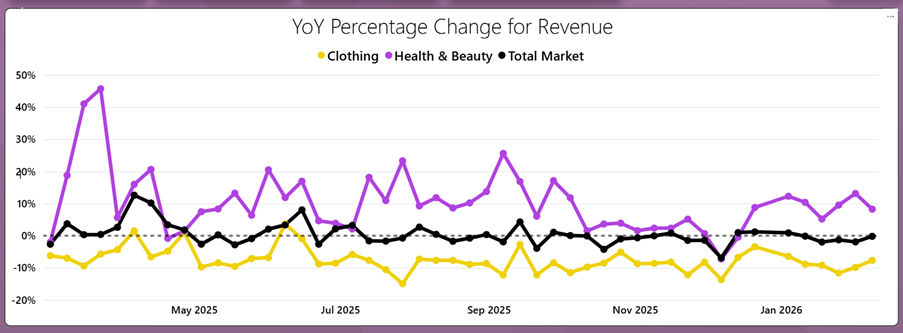
IMRG’s Online Retail Index which represents over £30bn in online spend shows that while Health & Beauty retailers consistently perform above the total market, Clothing consistently underperforms (See chart below).
Source: IMRG’s Online Retail Index
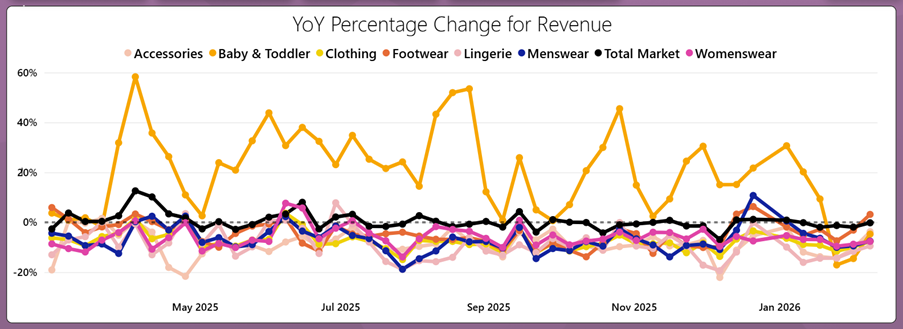
Clothing retailers experienced growth during the lockdown period, but since 2023 have seen declines. Looking at 2025 data, Clothing consistently underperformed compared to the total market (see chart below).
Source: IMRG’s Online Retail Index
The one standout sub-category of Clothing is Baby & Toddler, with growth higher than +50% year-on-year in some weeks.
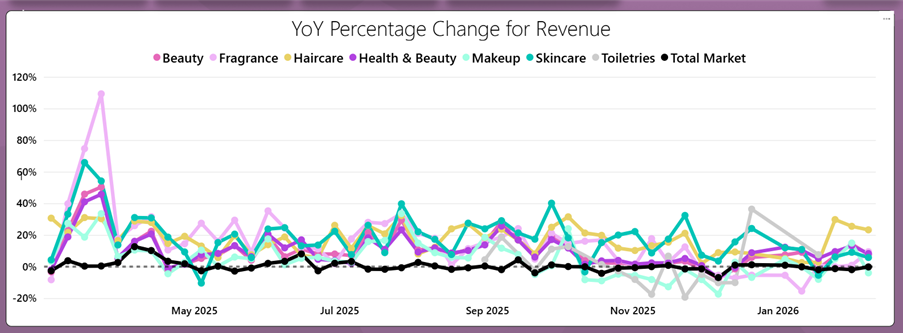
In comparison, all Health & Beauty sub-categories are performing well (see chart below).
Source: IMRG’s Online Retail Index
Haircare and skincare are top performers, with weekly growth above +20% year-on-year in most weeks. Haircare has seen growth as high as 30%+ year-on-year in January 2026. Beauty and skincare have also had a strong start to 2026.
The big spike for Fragrance in March was due to Mother’s Day falling in a different week in 2025 versus 2024. Fragrance performance has slipped away slightly so far in 2026.
IMRG’s 2026 forecast for Fashion and Beauty in the context of other categories:
Sports and outdoors: +8%
Health & Beauty: +5%
Gifts: +2%
Home & Garden: +1%
Electricals: 0%
Clothing: -4% YoY
Expert metric analysis
We spoke with our community of industry experts who shared further insights on fashion and beauty online performance.
Lewis Husbands, Client Success Specialist at ShoppingIQ said, ‘We’ve seen premium/luxury conversion rates fall YoY, for some brands hitting 4% in Jan/Feb 2025 to around 3% in 2026. This has not been helped by rising CPCs.’
He noted how ‘Mid-Tier brands’ conversion rate remained relatively flat for many clients around 1%, but they required increased spend to get the same results.’
‘Health products conversion rates have fared better YoY with some seeing modest growth in sales and revenue.’
Lewis explained, ‘This combination of rising CPCs and consumers shifting to lower order value means margins are being squeezed.’
‘We predict that consumers will also take longer to convert on items over £50, taking more time, more clicks and more spend.’
We also spoke with Nikhita Hyett, General Manager EMEA at Signifyd who revealed that according to their data ‘Fashion and beauty are entering 2026 on very different trajectories.’
‘Consumers are trimming their fashion baskets at checkout with a 3% drop in average order value. Beauty, by contrast, has seen AOV lift by 9% as consumers opt for “little luxuries”, contributing to 6% year on year sales growth, although order volumes are softening amid online inflation of around 5%.’
‘Both verticals now face increasing margin pressure, meaning retailers must protect profitability without introducing friction for genuine customers,’ said Nikhita.
Opportunities for Fashion & Beauty retailers
Making agility a core strategy
As performance pressures continue across both categories, agility and operational discipline are emerging as defining traits of the strongest performers.
From pricing and stock visibility to AI-driven experience, retailers are refining how they respond to real-time demand.
Customer insight & strategic agility
Aaron Stephens, VP of Global Retail at PXP shared that, ‘The retailers outperforming today are those who understand who their actual customer is, not who they assumed them to be, and are shaping product, pricing, and messaging accordingly.’
‘Agility remains critical,’ emphasised Aaron. ‘Brands are winning by responding quickly to unmet needs and using customer insight to guide product evolution.’
‘At the same time, operational discipline, including clearer refund strategies and thoughtful pricing personalisation, can protect revenue without eroding trust.’
Aaron said, ‘The leaders of 2026 will combine customer intimacy with smart, data‑driven execution.’
Pricing discipline & stock visibility
Hemang Nathwani, CEO and Co-Founder at Price Trakker echoed the value of being agile, specifically around pricing and stock visibility.
He shared, ‘One of the biggest shifts we are seeing in fashion and beauty is the move toward more smarter pricing and stock discipline.’
‘Retailers that are performing well are using real-time competitor and availability data to avoid over-discounting and protect margin.’
‘In beauty, strong growth continues to come from brands that focus on trust, consistency, and availability rather than aggressive promotions.’
‘Fashion retailers are also becoming more selective in range and launch strategies, supported by automation and data-led planning.’
‘Strong performers are those combining pricing insight, stock visibility, and faster execution rather than relying on traditional seasonal discount cycles,’ revealed Hemang.
AI & experience-led growth
Another way retailers are meeting preferences in real-time, helping them to stay competitive, is through AI.
Nate Barad, VP, Product and Technical Marketing at Algolia said, ‘Fashion, beauty, and luxury have always been visual, emotional categories; however, AI is amplifying that experience at scale.’
‘In 2026, agentic commerce, social platforms as transaction engines, and stricter sustainability standards are reshaping the path to purchase.’
‘Beauty is thriving through innovation and brand connection, while fashion can sharpen operational discipline and embrace circular models,’ said Nate.
Those who looking to succeed can ‘blend technological agility with authentic positioning, using AI to power “shop the look,” visual search, and hyper-personalized recommendations that reflect individual taste.’
Nate provided examples: ‘Retailers like L’Oréal, e.l.f., Revolve, and Frasers show that seamless physical-digital experiences and intelligence-led growth are what turn inspiration into confident, high-value conversion.’
Fashion & beauty fulfilment trends
Fulfilment is becoming a defining factor in performance across fashion and beauty.
From automation and regulatory compliance to localisation and delivery optimisation, retailers’ approaches can directly influence profitability and the customer experience in 2026.
Beauty & wellness: precision, personalisation and packaging
Andrew Scanlon, Head of Sales and Marketing at multichannel logistics and fulfilment providers Staci, Radial and Active Ants, shared how beauty and wellness fulfilment is evolving.
He explained that, ‘Beauty and wellness fulfilment places particular pressure on picking accuracy.’
‘In 2026, increased use of machine learning within warehouse management systems can help sharpen picking performance for beauty brands.’
Andrew said, ‘Algorithms can prioritise fast-moving actives such as hyaluronic acid, peptides and kojic acid, while also accounting for batch tracking, expiry dates and compliance requirements.’
As ingredient-led ranges, regulated products and advanced at-home devices continue to grow, operational precision is becoming increasingly important to protect both compliance and customer trust.
Regulatory pressure is also reshaping fulfilment decisions across the beauty category.
‘Packaging strategy is becoming more complex for beauty and wellness brands as legislation tightens and product ranges diversify.’
‘Rightsizing is particularly important for premium skincare, supplements and at-home devices, where overpackaging risks regulatory penalties and under-packaging risks damage or leakage.’
Alongside operational accuracy and compliance, Andrew also highlighted the strategic value of the post-checkout experience.
He noted that ‘Post-purchase personalisation has particular resonance in beauty and wellness, where education, ritual and repeat use are central to results.’
‘As social commerce continues to influence discovery… the moment after checkout becomes a key brand touchpoint.’
With repeat purchase and routine-based consumption central to category growth, reinforcing usage and engagement post-purchase presents a clear opportunity to strengthen lifetime value.
Fashion: localisation and operational agility
For fashion retailers in particular, fulfilment strategy must also address rising cross-border complexity and return rates.
Industry experts at fulfilmentcrowd explained how ‘Fashion retailers all face the battle of balancing speed, cost and sustainability.’
‘Unlike in health and beauty, fashion brands wrestle with high return rates, which become an even greater hurdle when serving customers globally.’
fulfilmentcrowd said, ‘Add ever-changing regulations to the mix, especially in places like the EU and US, and it’s clear why we believe stock localisation will be a defining strategy for top brands in 2026.’
‘By placing stock in key regions, retailers can reduce delivery times, minimise carbon-heavy international shipping and avoid increasingly complex import requirements.’
‘We’re already seeing great success with fashion brands by putting inventory closer to their customers throughout the EU and US,’ exclaimed fulfilmentcrowd.
Placing stock closer to key demand areas can improve speed, reduce friction and help manage regulatory exposure more effectively.
Delivery performance and category divergence
Delivery expectations are also shaping performance outcomes. Gavin Murphy, CMO at Scurri, commented:
‘Scurri Unpacked data shows how sharply category performance is diverging.’
‘In Q4 2025, Beauty shipments grew +10.3% YoY while Fashion declined -9.1%, reflecting pressure on discretionary spend.’
‘What stands out is delivery behaviour: more than 92% of Beauty parcels used Express, Next Day or Tracked Two-Day services, compared with 56% in Fashion.’
Gavin shared, ‘Speed and certainty now define premium performance. With overall shipment volumes up +17% YoY, growth is there but it’s concentrated in categories where delivery experience aligns with shopper expectations.’
‘In 2026, fashion and beauty retailers that optimise delivery choice, transparency and cross-border agility will outperform.’
As margin pressure continues across both categories, fulfilment is becoming not just an operational task, but a competitive differentiator.
In summary
As we move further into 2026, fashion and beauty are experiencing varying challenges, but both are under pressure to protect margin and stay close to changing customer expectations.
As explored by industry experts, the retailers that stay agile, make smarter operational decisions, and treat fulfilment and delivery as part of the overall customer experience may be better placed for growth.
Want to read more? Here are some recently published IMRG blogs:
Expectations for online trading in 2026 – IMRG
Christmas and Boxing Day sales 2025 Review – IMRG
Black Friday 2025: The data and insights are in! – IMRG
Published 25.02.26