

By Ellie-Rose Davies, Content Executive at IMRG
In this blog we review expectations for online trading in 2026, looking at our forecast and industry expert predictions on what can help drive growth.
Contents of this blog include:
- IMRG’s 2026 Forecast
- Introducing AI
- AI and discounting
- AI and product discovery
- AI and fulfilment
- Being ready to combat the negative side of AI
- Not forgetting the human element
IMRG’s 2026 Forecast
IMRG forecast that the total online market will achieve a year-on-year growth of… 0%. That’s right, we do not expect growth nor decline for the sector. This prediction is based on the trends revealed by our Online Retail Index.
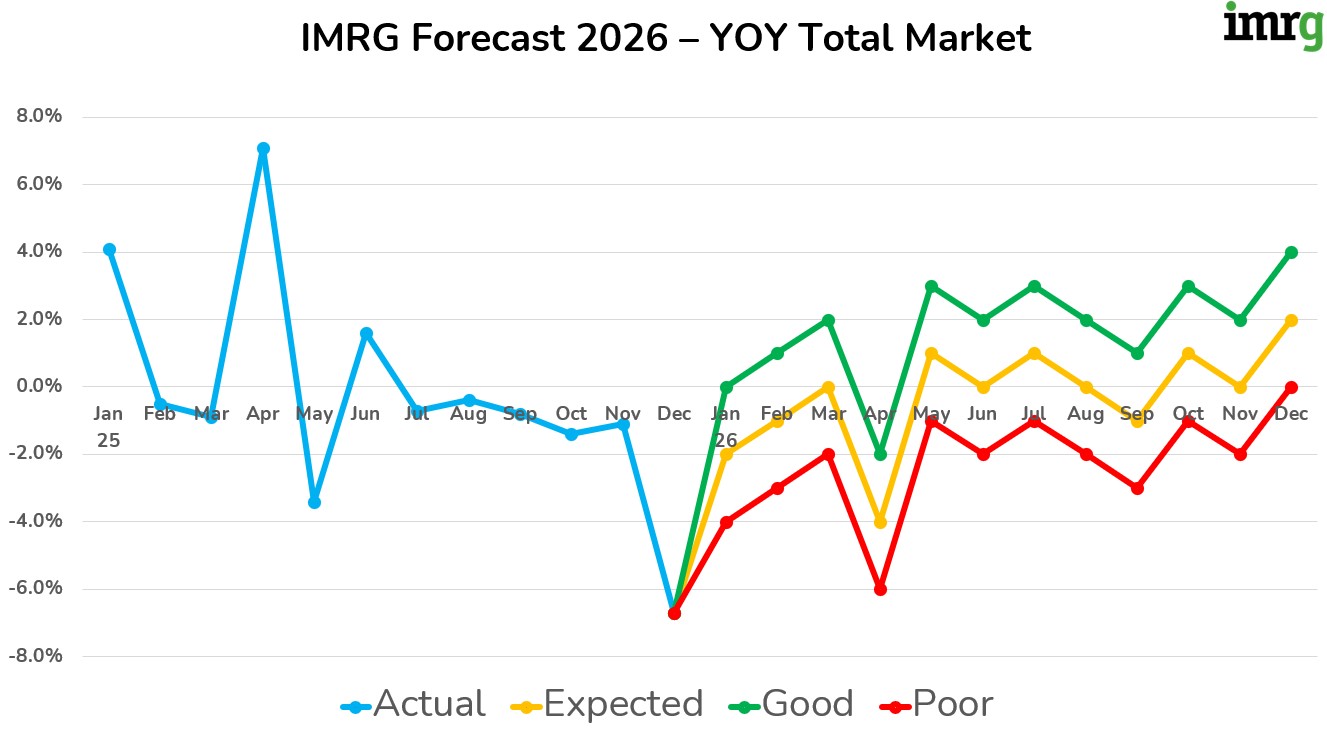
Source: IMRG’s Online Retail Index and 2026 Forecast
The chart above shows the actual performance for 2025, that then leads into expected performance for 2026 (yellow line), and what good growth could look like (green line), as well as poor performance (red line). We can expect growth in months such as May, June, and July, but declines in April and September.
The forecast for the start of 2026 has been on the right lines, where the result for January was -3.7% YoY.
Our online product category forecast is:
Clothing: -4% YoY
Electricals: 0%
Gifts: +2%
Health & Beauty: +5%
Home & Garden: +1%
Sports and outdoors: +8%
We anticipate that Health & Beauty and Sports & Outdoors will continue the positive momentum seen in recent years, and we unfortunately believe Clothing will experience yet another decline.
Retailers have revealed to us the top areas of interest for this year include customer-focussed strategies, such as UX and retention, but a core focus area is on AI. Our community of industry experts have also provided their expectations for online trading in 2026, with most reflecting on how AI will be at the forefront of strategies. Here’s what they have to say on the topic…
Introducing AI
We asked our community of industry experts to tell us their top expectations for online trading in 2026 and most reflected on AI.
Nikhita Hyett, General Manager EMEA, Signifyd describes how ‘AI will remain central to online trading in 2026, not as a feature but as part of the infrastructure of how commerce works.’
‘Agentic shopping shifts decision-making earlier, with intent increasingly shaped by systems that can essentially act on a customer’s behalf – overcoming complex multi-step buying journeys that are tailored exclusively to each customer.’
Because of this, Nikhita reveals how ‘Brands will have to work to be more relevant and trusted within AI-mediated journeys rather than reacting once the shopper is already ready to buy.’
Similarly, Marketing Services Director, Rebecca Wilkes at Summit Media shares that ‘Looking ahead to 2026, we’re expecting to see a further shift towards practical AI implementation – during 2025 there has been a lot of buzzwords, hype and testing.’
‘We’re expecting retailers to really push forward with innovation in the AI space, using learnings from 2025 to continue to embed AI into real world application, from smarter feed optimisation and onsite content, to preparing and measuring ads within AI driven platforms.’
Rebecca notes how ‘The rise of Agentic AI will push this further, but despite broadly positive consumer sentiment, the barrier continues to be trust and retailers must work on transparency in privacy and data usage within AI to support consumers engaging.’
She also reflected on other areas that can help retailers achieve growth, and those are embracing the ‘in-store experience’ and ‘social commerce.’ Rebecca reinforces the value of ‘quality product feeds to diversify into new channels,’ and ‘delivering to short term ROAS KPIs, building connections with their consumers through quality, engaging content.’
AI and discounting
A core AI use case in 2026 is through pricing and discounting. What this means is that retailers can avoid doing unnecessary steep discounts, but targeted promotions that meet consumers’ expectations and protects margin.
Hemang Nathwani, CEO and Co-Founder at Price Trakker shares, ‘In 2026, online retail will be shaped less by headline discounting and more by precision and trust.’
‘Retailers are increasingly expected to price consistently, fulfil reliably, and personalise engagement based on real behaviour rather than assumptions.’
Hemang says, ‘AI will continue to play a role, particularly in areas such as product matching, pricing intelligence, and demand forecasting, but only where it delivers clear commercial outcomes.’
‘Customers are becoming more price-aware and less tolerant of erratic promotions, meaning data-led decision making will be critical to protecting both margin and loyalty.’
Dan Bond, VP of Marketing at RevLifter agrees, stating that ‘AI will remain a dominant topic in 2026, but the conversation is shifting from “can we use AI?” to “how do we use it without eroding margins?”’
He says, ‘The real opportunity lies in understanding which customers actually need an incentive to buy and which would convert anyway. Shoppers have been trained to expect discounts, and breaking that cycle requires smarter targeting rather than deeper cuts.’
Dan tells retailers that ‘The likely winners this year will be those who protect their margins by being more selective about when and where they discount, rather than treating every visitor the same way.’
AI and product discovery
Another area where AI is expected to have a significant impact in 2026 is product performance and discovery. As purchasing journeys continue to spread across marketplaces, regions and AI-driven interfaces, visibility is increasingly shaped before a customer even reaches a retailer’s site.
Alexander Otto, Head of Corporate Relations at Tradebyte, highlights how this shift is redistributing online trading. He says:
‘In 2026, online trading is being redistributed as discovery fragments across marketplaces, regions and AI-driven interfaces, and algorithms increasingly determine what shoppers see long before they reach a product page.’
‘As such, AI is moving beyond basic automation to actively steer trading decisions, supporting demand forecasting, pricing optimisation, stock allocation and content alignment across channels.’
‘For brands, the competitive advantage can lie in structured product data, real-time availability and pricing consistency, now essential for ensuring products appear and perform reliably across platforms, and increasingly, in LLM-led product discovery.’
This has clear impact on how retailers may look at and approach their product information. As AI tools may greatly influence purchases this year, the quality and structure of data can directly link to performance.
Justin Thomas, VP Sales, EMEA North at Akeneo, comments on this, saying ‘In 2026, AI will no longer be a differentiator but a baseline expectation. As AI-led search, agents and recommendations increasingly influence, or even complete, purchases, product information becomes mission-critical.’
‘Consumers will expect instant, accurate and contextual answers wherever they shop, often beyond a retailer’s own platform. Retailers that spend time structuring, enriching and governing their product data can unlock AI’s full potential,’ says Justin.
Alongside changes in technology, consumer behaviour is also evolving. Andra Muntean, Senior Marketing Manager EMEA at Athos Commerce, reflects on how ‘The 2025 holiday season highlighted a growing gap between shopper expectations and traditional site architecture.’
‘With mobile and social channels maturing into primary storefronts, many teams saw a rise in zero click intent where shoppers expect products to find them. When on-site search or category pages feel disconnected from these entry points, it creates a friction that today’s shoppers simply do not tolerate. They often move to marketplaces where the experience feels more intuitive.”
Looking ahead to 2026, consistency can be a challenge.
Andra notes that ‘For many retailers, the challenge in 2026 is not a lack of traffic but the operational tax of managing discovery in silos.’
‘Moving away from manual, surface level fixes toward a unified decision layer can allow for a more consistent experience. By treating discovery as a single and coherent system across search, browse, and feeds, brands can turn passive infrastructure into a genuine engine for growth.’
Taken together, these ideas show that ensuring product data is structured, consistent and aligned across channels can enable brands to remain visible and competitive as discovery becomes more complex.
AI and fulfilment
As retailers look to protect margin and strengthen retention in 2026, attention is turning to fulfilment as a key part of overall performance. AI is increasingly being applied not just to front-end experiences, but to the operational decisions that shape reliability, cost and customer satisfaction.
Experts at fulfilmentcrowd believe the focus will move beyond ambition to measurable impact:
‘AI will remain a dominant topic in 2026, but its value will be judged on outcomes, not ambition. From a fulfilment perspective, that means using technology to make smarter decisions in real time, improving reliability, resilience and consistency at scale.’
They add:
‘Customers aren’t necessarily demanding more but are far less forgiving when delivery or communication falls short. Because of this, fulfilment isn’t just an operational concern, but a visible part of customer experience and a driver of business growth.’
For many retailers, this reinforces a broader shift: fulfilment is no longer simply about efficiency but about protecting brand equity and repeat purchase.
Rory O’Connor, Founder & CEO at Scurri, comments says, ‘In 2026, AI will move from experimentation to expectation.’
‘Retailers will increasingly rely on AI not just for discovery and personalisation, but to orchestrate the entire customer journey, including delivery choice and post-purchase experience.’
As more transactions take place beyond traditional storefronts, delivery may become one of the few consistent brand touchpoints.
Rory says, ‘As social and AI-led commerce shift transactions off traditional storefronts, fulfilment can become the anchor for the brand. Consumers will expect speed, transparency and control wherever they buy. Retailers that connect AI-driven front-end experiences with intelligent, automated fulfilment can be best positioned to convert demand into long-term loyalty.’
Andrew Scanlon, Head of Sales and Marketing at Staci, Radial and Active Ants, highlights post-purchase personalisation as an area of opportunity.
He reveals, ‘Growth in social commerce and changing eCommerce habits are likely to drive growth in on-pack and in-pack personalisation.’
‘Post-purchase personalisation offers huge potential for retailers and brands to leverage the visual, sharing and virality of social commerce.’
Andrew shares, ‘Customised packaging and promotions can super-charge unboxing, helping businesses to boost brand awareness. Personalisation can also drive cross-selling and upselling, enabling retailers and brands to grow basket values and repeat purchasing.’
Taken together, these perspectives suggest that in 2026 fulfilment will play a more central role in commercial performance.
Considering fulfilment further, Alexandra Romantseva, Head of Marketing at ReBound and Advanced Supply Chain explores how returns can be a core strategy for growth this year.
Alexandra says, ‘Growing consumer preferences for marketplaces, recommerce and sustainability can increase the complexities of goods being sent back by shoppers.’
‘There’s a risk of reverse logistics processes becoming longer and more fragmented, and this occurring at a time when legislation and consumers increasingly require supply chains to be more resourceful. Businesses are embracing this as an opportunity to rethink returns strategies.’
‘Emphasis is being placed on treating returns as a strategic driver for supporting sales, customer satisfaction, sustainable practices and cost management,’ shares Alexandra. ‘Sophisticated tech is enabling this and it’s why, for example, we see around a third of professionals (31%) prioritising portals for e-commerce returns, and technical capabilities ranking highly during the outsourcing of returns.’
Being ready to combat the negative side of AI
With AI on the rise, it’s important to stay alert of the fraudulent activity that can come with it.
Barley Laing, the UK Managing Director at Melissa, argues ‘In 2026 the eCommerce sector can expect to see a large increase in fraudulent activity, largely powered by AI.’
‘For those who are unprepared, fraud may have a significant negative impact on their already tight bottom lines, and reputation.’
‘Today, it’s important that those in ecommerce put ID verification procedures in place to ensure those buying their products and services are who they say they are. This starts with having access to accurate customer contact information – such as name, address, email and phone number. It helps to make the identity verification process more reliable.’
This is where Barley recommends retailers to ‘Consider mobile ID verification – matching a name to a mobile number. With the majority of the world’s population having access to a smartphone a mobile number is fast becoming a key part of the identity verification process, and in the fight against fraud.’
‘Electronic ID verification (eIDV)’ can help with this as in real-time it ‘cross-checks the names and addresses’ provided by customers online.
Barley says retailers can also ‘monitor the IP addresses of those looking to purchase big ticket items, to make sure they match or are near the verified physical address they have provided.’
Not forgetting the human element
It is important that as retailers focus on AI this year, that they also remember the importance of the human element.
Molly Elrington, Retail and Travel Client Partner at Awin reflects on how retailers can meet consumers’ expectations around the human-touch. She says, ‘Community is going to be a defining force in online retail in 2026.’
‘As AI becomes more embedded in how we browse, buy and discover, consumers are simultaneously craving the human element – connection, trust and authenticity.’
‘Brands that nurture partnerships with reliable and trustworthy editorial sites or deepen partnerships with micro and nano‑influencers can be best placed to reach consumers seeking that sense of community.’
‘At Awin, we’ve seen continuous growth in brand partnerships, where retailers share offers and gain access to one another’s audiences. This kind of value exchange feels personal, relevant and community‑driven, which is exactly what customers will be drawn to in 2026,’ shares Molly.
In what IMRG predict as a flat year for eCommerce, growth in 2026 may be found through using AI responsibly and commercially, managing risk carefully, and not losing sight of the human relationships.
Want to read more? Here are some other IMRG blogs that may take your interest:
Christmas and Boxing Day sales 2025 Review – IMRG
Turning competitor data into smarter range decisions – IMRG
Turning competitor data into smarter range decisions – IMRG
Published 13/02/26