

By Ellie-Rose Davies, Content Executive at IMRG
In this blog we will explore how the total online market performed over Christmas and Boxing Day, looking at trends across product categories and customer purchasing behaviour. IMRG spoke with industry experts to provide you with key lessons for the festive period of 2026.
Contents of the blog include:
- IMRG December data and insights
- Industry perspectives on peak trading
- Pricing and promotional strategies
- Fulfilment performance during peak
- Changing shopper behaviour and earlier planning
IMRG December data and insights
The first half of online trading in 2025 was pretty good, but the second half didn’t perform to the same extent. After a long period of misery, eCommerce felt like it was back, but then growth fell away again.
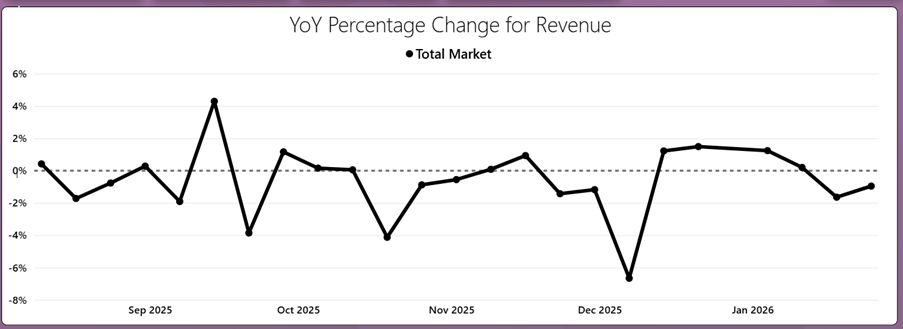
Source: IMRG’s Online Retail Index
Looking at December, the week commencing 7th saw the worst performance, at -6.7% YoY. Interestingly, this is the week where Black Friday/Cyber week had been and gone. The only online product categories that did well this week was Gifts, Baby & Toddler, Skincare, Sports & Outdoors, Large Appliances and Home Improvements. Lots of the other product categories were -10% YoY and worse.
The week leading into Christmas and Boxing Day (w/c 21st December) saw slight growth, at +1.5% YoY. This was led by Gifts retailers who saw astronomical growth of +62.6% YoY. Jewellery and Health & Beauty also saw strong performances.
The year-on-year figure for December as a whole was -7.2%.
Industry perspectives on peak trading
While our Index highlights how trading performed across December, industry experts point to a more complex picture of consumer behaviour and trading dynamics across the Golden Quarter.
Alfie Staples, Customer Insights & Strategy Lead at Awin shares that ‘As expected, purchasing had been tentative across the golden quarter, a triple header of the cost-of-living crisis, pre-Christmas budget and Cyber absorbing a disproportionate share of marketing investment.’
This caution appeared to extend beyond peak promotional moments. ‘Whilst Boxing Day always comes out swinging, post-Christmas it failed to connect with the consumer despite 1/3 of them utilising a voucher, up 10% from 2023 with overall sales volumes being down day-on-day relative to the last few years.’
Reflecting on the broader context, Alfie continues, ‘Whilst it’s hard to pinpoint the exact reasons why is clear is that the golden quarter is a marketing landscape in flux, not defined by a single few separate moments, but ones that are intertwined.’
From a fulfilment and volume perspective, Rory O’Connor, Founder & CEO at Scurri, observed a different set of dynamics emerging from their market data. He notes that ‘the last Monday before Christmas day had the highest volume, up 29% YoY. Christmas Eve was down 7.5% YoY in volume while Boxing Day was up 25% YoY.’
At a category level, Scurri also identified strong performance in several areas, noting how ‘the full week of Christmas cosmetics were up 24.5%, Fashion up 20.3%, Food & Drink up 15.8%, and Toys up 21.7%.’
Pricing and promotional strategies
Expert analysis suggests that Christmas trading followed a different dynamic to Black Friday, with customer intent moving slightly away from deal-hunting towards gift certainty.
Dan Bond, VP Marketing, RevLifter notes how ‘Christmas shopping runs on a different psychology than Black Friday. During Black Friday, customers are on the hunt for deals.’
‘At Christmas, they’re focused on finding the right gift, which is why December consistently shows lower discount activity, despite being the second-highest revenue month.’
Dan shares how ‘Boxing Day has become an extension of peak season for many shoppers. Still, the smartest retailers view it as an opportunity to clear specific inventory rather than applying blanket price cuts across the board.’
‘The retailers who performed best this season understood that customer intent shifts throughout December and adjusted their approach accordingly,’ says Dan.
Similarly, Hemang Nathwani, CEO and Co-Founder at Price Trakker explores how ‘Christmas and Boxing Day trading in 2025 continued the shift we saw during Black Friday toward longer promotional periods and more measured discounting.’
‘Retailers that performed well tended to focus on clear messaging, predictable offers, and reliable fulfilment rather than aggressive last-minute price cuts.’
‘Boxing Day itself felt less like a single spike and more like a continuation of December trading, with shoppers responding positively to availability and delivery certainty.’
Hemang continues, ‘Compared to Black Friday, promotions were generally more controlled, and many retailers that avoided frequent price changes benefited from stronger customer confidence and fewer margin losses.’
Fulfilment performance during peak
As trading extended across multiple weeks, fulfilment reliability became an increasingly important driver of performance.
Paul Taylor, Chief Operating Officer at fulfilmentcrowd reflects on this, sharing ‘Christmas and Boxing Day sales 2025 highlighted a more considered and operationally demanding peak for online retailers.’
‘While demand remained strong, success was less about deep discounting and more about timely, relevant campaigns supported by resilient fulfilment,’ says Paul.
‘Unlike Black Friday’s short, high-intensity spike, Christmas trading required sustained performance across multiple weeks, with customers placing greater value on delivery reliability and transparency.’
Changing shopper behaviour and earlier planning
Alongside shifts in trading patterns and peak performance, expert insight points to changes in how and when customers are engaging, with evidence of earlier planning, increased research, and more considered purchasing behaviour across December.
Lewis Husbands, Client Success Specialist at ShoppingIQ highlights how retailers adapted to this behaviour earlier in the season. ‘With data points from over 50 of the brands that ShoppingIQ works with, across Google, Microsoft and Meta activity, we saw many retailers launch deals as early as Christmas Eve. This doesn’t just help capture the last-minute rush, but engages the ‘bargain hunter’ and ‘speculative shoppers’.’
He also notes that shoppers are spending more time researching before committing to a purchase particularly later in the day, ‘Signs suggested that by 10pm or 11pm shoppers have usually already made a time investment in researching and browsing. Once someone has invested this effort, they are more likely to want to justify it with a successful outcome, so when coming to your site they are primed and outcome oriented.’
This behaviour creates opportunities for retailers to respond with timely and relevant propositions. ‘By presenting a compelling, personalised deal or upsell at that precise moment helps give the customer that win they are looking for and the chance for the retailer to increase average order value.’
ShoppingIQ also observed patterns that support this more considered approach to purchasing. ‘In general, we see shoppers make several visits before purchase.’
Justin Thomas, VP Sales, EMEA North at Akeneo, echoes how customers are spending time to make decisions and notes the growing role of technology in this:
‘Christmas 2025 showed how AI is reshaping peak trading, particularly in product discovery and decision-making. Shoppers came earlier and were better informed, relying on AI-powered recommendations and comparisons to buy with confidence.’
However, he notes that execution remained critical. ‘However, success depended on the quality of product information behind those experiences.’
‘Boxing Day demand reflected consumers seeking reassurance, clarity and value rather than just discounts.’
Comparing festive trading to Black Friday, Justin adds, ‘Unlike Black Friday’s price-driven urgency, festive trading rewarded brands that paired strong storytelling and personalisation with accurate, consistent and detailed product content to support confident purchase decisions.’
Next steps
Looking ahead, the findings from December suggest retailers may benefit from planning for earlier engagement, taking a more measured approach to promotions, and prioritising fulfilment reliability and clear customer communication.
Want to read more? Here are some other recent IMRG blogs that may take your interest:
Turning competitor data into smarter range decisions – IMRG
Black Friday 2025: The data and insights are in! – IMRG
Post-Black Friday customer retention strategies – IMRG
Black Friday 2025: An early snapshot of a sharper, smarter peak – IMRG
Using competitor availability data to anticipate market gaps – IMRG
Published 06/02/2026