

By Ellie-Rose Davies, Content Manager at IMRG
In this blog we will share how retailers can move their customers smoothly and confidently through the customer purchasing funnel.
Continue reading to gain insight on:
- IMRG customer funnel data
- Building trust before the click
- Growing confidence on the product page
- Reducing friction at checkout
- Improving delivery transparency & accountability
IMRG customer funnel data
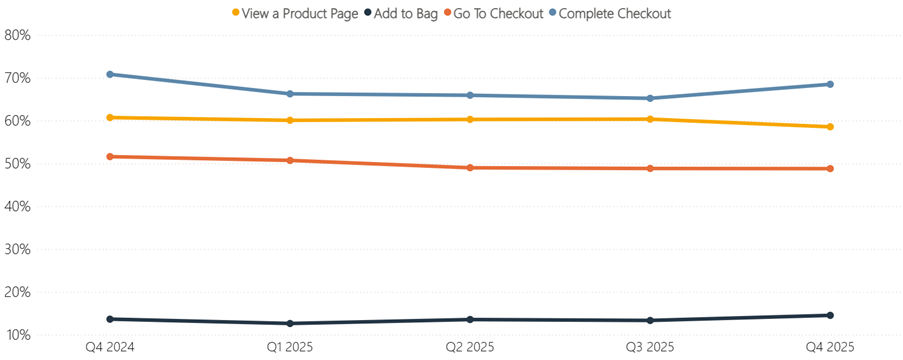
Source: IMRG’s KPI Hub data, Customer Funnel
Conversion rates at each stage of the customer funnel remain fairly consistent by quarter (see chart above).
However, the clearest point of friction continues to be the move from product view to ‘Add to bag’: just 13–15% of consumers will add an item to their basket after viewing a product page.
Retailers can prioritise optimising the product page to better support conversion.
This may include refining product descriptions, improving imagery, and clearly communicating information e.g., around pricing and delivery.
Strong calls to action and accurate stock visibility can further reduce hesitation. At this stage, small improvements in clarity and reassurance may result in stronger conversion.
Building trust before the click
Customer confidence begins before the product page.
The way retailers acquire traffic, position their brand and frame their value proposition can play a big role in shaping trust before the first click.
Przemek Wyszynski, Managing Director at RTB House, explains that ‘At its best, display advertising has always been about catching people before they really know they want something.’
‘Deep Learning intent models help retailers move beyond broad demographic targeting and identify high-intent users even before a product search occurs.’
‘That’s a sea change from a technical standpoint, but these ads may only pay off if they showcase the right products and tell the story of the brand behind them.’
Przemek continues, ‘So, a perfect combination is strong algorithmic intelligence and visual creatives that resonate.’
‘Such ad optimisation can create meaningful awareness, drive curiosity, and build trust in the brand.’
‘Done right, the user takes that journey all the way down the funnel with you.’
Trust can be reinforced through strategic partnerships that add relevance and value throughout the journey.
Amy Scully, UK Brand Partnership Consultant at Awin notes:
‘One of the most effective ways to build customer confidence throughout the purchasing funnel is by incorporating relevant, value-adding brands at key touchpoints.’
‘Thoughtfully selected partners, whether through checkout rewards, gift-with-purchase offers, or post-purchase perks, can reinforce trust and enhance the overall proposition.’
Amy describes how ‘The key to this is relevance, offers can complement the core purchase and feel like a natural extension of the customer journey.’
‘When done well, strategic brand partnerships can not only drive incremental revenue but reassure customers they’re getting added value, nudging them confidently towards conversion.’
Growing confidence on the product page
Once a customer reaches the product page, retailers can ensure that build confidence by making the page clear, transparent and accurate.
At this stage what is presented should help removes doubt, answer key questions and support a smooth path to checkout.
Justin Thomas Akeneo VP Sales EMEA North at Akeneo emphasises this, stating:
‘Customer confidence is now built on complete, transparent, consistent and intelligent product information at every touchpoint.’
‘Our latest PX Pulse research shows 77% of consumers actively look for sustainability details, while missing size, materials or visuals are the biggest barriers to purchase.’
Also, Justin shares that ‘As AI increasingly shapes product discovery and recommendation, retailers can ensure orchestrated, governed, attribute-rich data flows seamlessly from search to PDP to checkout.’
He reveals that ‘Structured sustainability, sourcing and compatibility data can help increase customers’ trust and loyalty but also can improve conversion.’
‘In 2026, confidence and success may well depend on managed, consistent and clean data, joined to a single authoritative product source of truth, activated across every channel, interface and buying moment.’
Pricing and availability consistency can also play a central role in reinforcing trust at this point in the journey.
Hemang Nathwani, CEO and Co-Founder at Price Trakker echoes how ‘Customer confidence today is driven by clarity and consistency at every stage of the journey.’
‘From product pages to checkout, shoppers want transparent pricing, reliable delivery, and accurate availability.’
He argues that the ‘Retailers who succeed are those using automation to keep prices aligned across channels, reduce stock surprises, and provide realistic delivery promises.’
‘Trust grows when customers see stable pricing and fulfilment that matches expectations.’
Hemang reflects on how ‘Retailers may also use behavioural data to personalise communication without overwhelming customers.’
‘In 2026, the brands that are likely winners are those that combine automation, accurate data, and clear messaging to remove friction and make the buying process feel simple and predictable.’
Reducing friction at checkout
Checkout is where confidence is most commonly heavily tested.
Even small moments of hesitation, e.g., around payment choice, data entry or messaging, can lead to abandonment.
Retailers that reduce complexity and remove doubt at this stage are more likely to see customers complete their purchase.
Dan Bond, VP of Marketing at RevLifter opens this conversation through stating that ‘Most conversion problems aren’t price problems. They’re information problems, friction problems, or trust problems.’
‘A shopper who abandons at checkout usually needed something the page didn’t give them: Reassurance about returns, clarity on delivery, or simply a reason to act now rather than later.’
Dan explains, ‘The retailers with strong funnels tend to think about each stage as a question the customer is asking.’
‘On the product page: “Is this right for me?” At checkout: “Is this safe?” The job of good onsite messaging is to answer those questions before the customer has to go looking for the answers elsewhere.’
Aaron Stephens, VP of Global Retail at PXP reflects on how to reduce friction at the checkout with payments.
He says, ‘Confidence is built at checkout when customers see their preferred payment method presented without clutter.’
‘Too many options can create hesitation. Too few limits reach. Many retailers understand that they don’t need every BNPL provider or digital wallet, but the right ones that speak to their customers.’
Aaron notes how ‘That takes flexibility, not a one-size-fits-all eCommerce setup.’
‘The real advantage can come from combining behavioural and payments data at each funnel stage to identify where a new payment method reduces drop-off or where doubling down drives completion.’
Alongside payment optimisation, data accuracy plays a critical role in delivering a smooth experience.
Barley Laing, the UK Managing Director at Melissa, argues that a good approach to ‘discourage cart abandonment, deliver a standout customer experience and encourage repeat custom’ is to ‘collect accurate customer contact data at the onboarding stage in real time, so there’s no impact on the customer journey.’
‘A good starting point is to use an address lookup or autocomplete tool that automatically provides the correct address as the customer starts to enter theirs.’
Barley exclaims, ‘Collecting accurate address data in this way ensures there’s no mistakes caused by fat finger syndrome, and there’s a reduction in the number of keystrokes required when typing an address by up to 81%.’
In turn, ‘This results in the path to checkout being speeded up and reduces the chance of a basket being abandoned – assisting the delivery of a sale and a standout customer journey.’
Improving delivery transparency & accountability
Delivery transparency is increasingly influencing decisions well before checkout. Providing clear delivery options and timelines earlier in the journey can reduce hesitation and strengthen intent.
Gavin Murphy, CMO at Scurri comments, ‘Consumer confidence depends on delivery clarity earlier in the funnel, not at the checkout.’
‘Scurri Unpacked data shows that in Q4 2025, Next Day volumes rose 11.6% and Weekend delivery 24.2%, highlighting how strongly speed and flexibility influence purchase decisions.’
‘In Beauty, where 92% of shipments used expedited services, delivery is part of the product promise itself,’ says Gavin.
‘Retailers that surface accurate delivery dates, clear tracking and flexible options at PDP and basket stage can reduce friction and increase conversion.
‘In 2026, delivery transparency will be a primary trust signal, directly shaping repeat purchase and long-term loyalty.’
Paul Taylor, Chief Operating Officer at fulfilmentcrowd adds, ‘Retailers often optimise the most customer-facing areas of the funnel, but true long-term customer confidence is built on operational accountability.’
‘Clear delivery messaging, transparent returns policies and accurate stock visibility all reduce any moments of hesitation at the checkout screen.’
Paul also explores how ‘Modern customers want certainty as well as speed, so the retailers that communicate realistic delivery windows and simple returns options may likely see stronger conversion over time.’
‘By limiting perceived risk for the consumer by aligning marketing promises with fulfilment capability, brands can immediately build trust with shoppers, see greater conversion gains and preserve business reputation,’ says Paul.
To conclude
Customer confidence can be built gradually across the purchasing funnel.
From smarter acquisition and relevant partnerships, through clear and consistent product information, to a frictionless checkout and transparent delivery experience, retailers that focus on clarity, accuracy and alignment are more likely to reduce hesitation, can strengthen conversion and build long-term trust.
Want to read more? Here are some recent IMRG blogs that may take your interest:
Beyond the buzz: making AI foundational to commerce – IMRG
Fashion and Beauty eCommerce trends for 2026 – IMRG
Maximising the impact of AI in 2026 – IMRG
Expectations for online trading in 2026 – IMRG
Published 06/03/26
