

By Ellie-Rose Davies, Content Manager at IMRG
Black Friday is still some time away, but a few retailers’ campaigns are already live. How early will shoppers start buying, and what could that mean for trading through December?
Using IMRG data and commentary from our members, we look at the likely timing of demand, how shoppers will find products, and the delivery and returns pressures retailers may face this Peak.
Will Peak start earlier again?
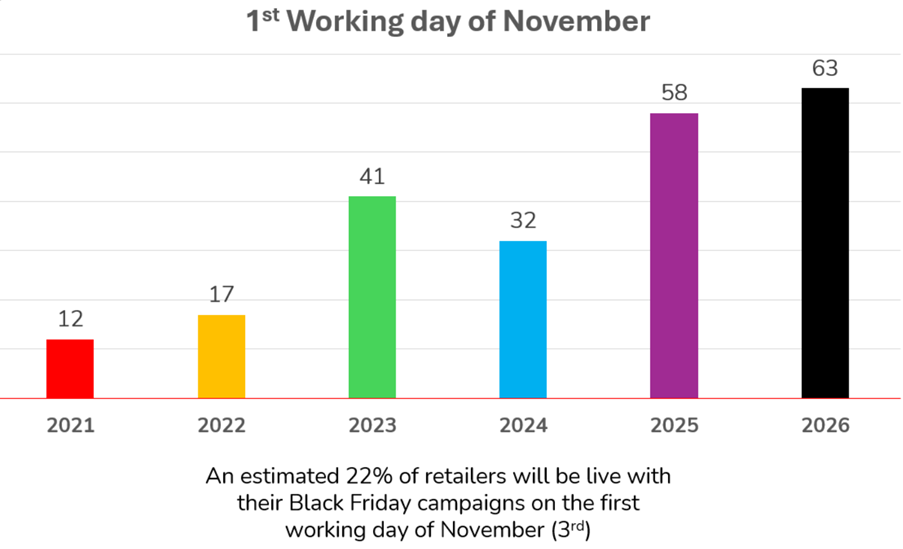
This year IMRG predict 22% of retailers will be live with a Black Friday campaign on the first working day of November. This is a prediction based on historic launch date trends, derived from IMRG’s Black Friday tracker, alongside current market data.
Over the years we have seen Black Friday campaigns start earlier and earlier, this year some are even live now!
Shoppers are getting started early too. RTB House’s research suggests many begin looking for deals more than two weeks before Peak, giving retailers a reason to build awareness well before Black Friday itself.
Przemek Wyszynski, MD – UK&I at RTB House says, ‘Peak 2026 will be won long before Black Friday begins.’
‘Fospha’s Peak Period Playbook found that top performing brands maintained at least 15% of their budget in Awareness and Consideration throughout the year. Meanwhile RTB House’s latest research shows 59% of UK consumers start searching for deals over 2 weeks before peak begins.’
Przemek argues that ‘Retailers need channels such as display to inspire and build consideration before peak begins in order to make sure their brand makes the mental shortlists created by consumers – then win the shortlist during Black Friday and Christmas and remain active afterwards while valuable audiences are still converting.’
But an earlier start to promotions doesn’t necessarily mean shoppers will rush to buy. Jessica Elliot-Kim, Client Partner at Awin, expects them to be more selective about which offers are worth acting on.
Jessica says, ‘With retailers launching promotions earlier each year, and many “deals” proving cheaper at other points in the calendar, shoppers are likely to approach Black Friday with more caution and lower expectations.’
‘Rather than waiting for the traditional Q4 peaks, consumers may be more inclined to act when a compelling offer first goes live, regardless of the season, which could spread demand across a wider trading window,’ reveals Jessica.
If more shoppers buy earlier, what could that mean for December? Rob Watson, Principal Advisor at Columbus Digital Commerce, looks at how demand may shift across the rest of Peak.
Rob says, ‘I expect online sales to end 2026 largely flat, but phased earlier. A weak spring gave way to a stronger early summer, and early discounting pulled some spending forward.’
‘Black Friday will probably do the same to December, which fell 7.2% online last year.’
Rob shares that ‘Consumer confidence has climbed 11 points since April to a two-year high. But inflation is rising, and a rate rise looks possible, so shoppers will research harder before they buy.’
‘AI has changed how shoppers will find products this Christmas. Retailers need product content that answers longer, intent-led searches. AI Max for Shopping, for example, builds ads from rich product information,’ says Rob.
How will shoppers find products this Peak?
IMRG data shows that the channels with the highest conversion rate during Black Friday are paid search (5%), organic shopping, and direct network. But there are also other ways consumers will find products this Peak.
As shoppers move between search, social platforms, marketplaces and AI tools, retailers may need to think more broadly about how they appear during the research stage. Jessica Elliot-Kim, Client Partner at Awin, expects content to play a bigger role.
Jessica says, ‘In previous years, incentive partners dominated the Golden Quarter within affiliate marketing.’
‘However, as AI becomes a bigger part of the shopping journey, upper-funnel activity is set to play a more important role this discounting season.’
‘Trusted, high-quality content will be essential for securing meaningful exposure, while the need to optimise for AI visibility creates a new consideration for budget planning,’ argues Jessica.
‘At Awin, we have already seen a 41% increase in advertiser spend with content creators, showing that this shift is already underway and likely to continue.’
On Amazon, that shift is already changing the information shoppers see when they search. Alex Karagiannis, CEO of Lezzat Amazon Agency, explains:
‘Discovery is moving into the AI layer.’
‘On Amazon we already see Rufus answering questions that used to be typed as search terms, and it pulls from structured attributes found in A+ content and reviews rather than keyword-stuffed titles. Retailers who treat listing attributes as a database rather than ad copy will get found this peak; those who don’t will lose visibility they never see reported.’
He says to retailers, ‘Audit your attributes, fix the contradictions between bullets, images and spec fields, and make sure reviews answer the questions shoppers actually ask. Do that work early, not in Black Friday week.’
That puts more weight on the quality of product information. Justin Thomas, VP Sales – EMEA North at Akeneo, sees it as a foundation for both AI-assisted discovery and the customer experience that follows.
Justin shares, ‘Peak 2026 will highlight a growing divide between retailers simply experimenting with AI and those building the foundations for AI-powered discovery and agentic commerce.’
He reveals that ‘product information a critical growth asset. AI can only discover, understand and confidently recommend products when the underlying product data is accurate, enriched, contextual, governed, and machine-readable.’
‘Brands and retailers, therefore, show think beyond optimising product information for traditional search and eCommerce channels and ensure it can also be understood and accurately represented by AI, says Justin.
Alexander Otto, Head of Creative Marketing & Events at Tradebyte considers what it takes to give shoppers a consistent experience as they move between sales channels:
‘Last year’s peak season showed just how much demand online retail can absorb: Tradebyte customers saw sales grow 19% year-on-year during the 2025 peak period. That provides a useful benchmark for what retailers should prepare for in 2026.’
‘As shoppers move between marketplaces, social channels and brand sites, retailers need the infrastructure and product data to deliver a consistent experience wherever discovery happens’
‘AI will increasingly influence that journey, from personalised recommendations to helping shoppers compare products and make decisions, but it also raises the bar for the underlying data feeding those experiences.’
Alexander says, ‘The fundamentals remain unchanged: accurate product information, reliable fulfilment, competitive pricing and the ability to scale across channels. Retailers that get these foundations right will be better placed to turn peak demand into lasting customer relationships.’
What happens after the customer clicks buy?
Being visible across channels is one challenge; meeting expectations once an order comes in is another. With promotions starting earlier, retailers may need their delivery and returns plans ready for a longer Peak period.
fulfilmentcrowd sees reliable delivery as central to the customer experience, however a shopper discovers a product:
‘AI will make this peak season fundamentally different at the top of the funnel, helping shoppers compare products and make purchasing decisions faster than ever.’
‘This is likely to make pre-purchase competition even tougher, but once an order’s placed, the fundamentals haven’t changed.’
‘Customers still expect the right product, delivered when promised, with clear communication if something goes wrong.’
‘Retailers should embrace AI for product and discount discovery, but not at the expense of operational readiness. No matter how a customer finds your products this peak, reliable fulfilment remains what turns that purchase into a positive brand experience,’ says fulfilmentcrowd.
Preparing for that demand may be more complicated if orders arrive across a longer window. Gavin Murphy, CMO at Scurri, explains what retailers should consider ahead of their first promotion:
‘Peak 2026 is likely to be flatter rather than one volume spike so retailers should prepare for demand spread across November, rising expectations around delivery certainty and pressure on fulfilment costs.’
‘A flexible, tested multi-carrier strategy will be essential, supported by live performance data and credible delivery dates at checkout.’
Gavin notes how ‘AI can improve forecasting, choose the best carrier for each order and identify shipments at risk before customers complain. However, technology cannot rescue weak preparation.’
‘Retailers still need aligned marketing and logistics plans, carrier capacity, proactive customer communications and a returns operation ready before the first promotion launches.’
The pressure doesn’t end when orders are delivered. Liselotte Reijrink, Sales Director at ReBound Returns, expects returns volumes to remain high well beyond Black Friday.
Liselotte says, ‘Retailers should prepare for another significant increase in returns this peak season, with pressure on returns continuing to grow year on year.’
‘Between 2024 and 2025, our data shows the December returns peak increased by around 23%. The upward trend continued into January 2026, when peak returns were around 24% higher than the previous year, suggesting this year could see the biggest peak returns period yet.’
She says, ‘Returns begin to rise sharply during Black Friday week itself, suggesting some shoppers are returning orders almost immediately after receiving them.’
‘The biggest returns peak of the year tends to fall in the second week of December, before volumes begin to ease.’
‘However, 2025 figures suggest the post-Christmas lull may be disappearing. Twixmas returns remained in the top third of weekly returns figures for the year, compared to 2024 where they dipped significantly.’
‘Retailers should therefore plan for sustained reverse-logistics pressure from Black Friday through into the New Year,’ says Liselotte.
In summary
This year’s Peak could bring a longer promotional period, with sales spread more widely across November and December.
Shoppers will have more ways to research and compare products, but their expectations after placing an order remain familiar: accurate information, delivery as promised and a straightforward returns experience.
How well retailers manage each part of that journey will matter beyond Black Friday itself.
Published 14/10/2026
