

By Ellie-Rose Davies, Content Manager at IMRG
Across the IMRG community, AI continues to be a key focus this year. But as adoption grows, the conversation is moving beyond whether retailers are using AI to where it is delivering the most value. From product discovery and conversion to operations, fulfilment and post-purchase, we explore where retailers are seeing the greatest impact.
It starts with the data: becoming AI-ready
For retailers to get value from AI, the quality of the data feeding it matters.
Source: IMRG’s retailer survey at Tech & AI Connect 2026
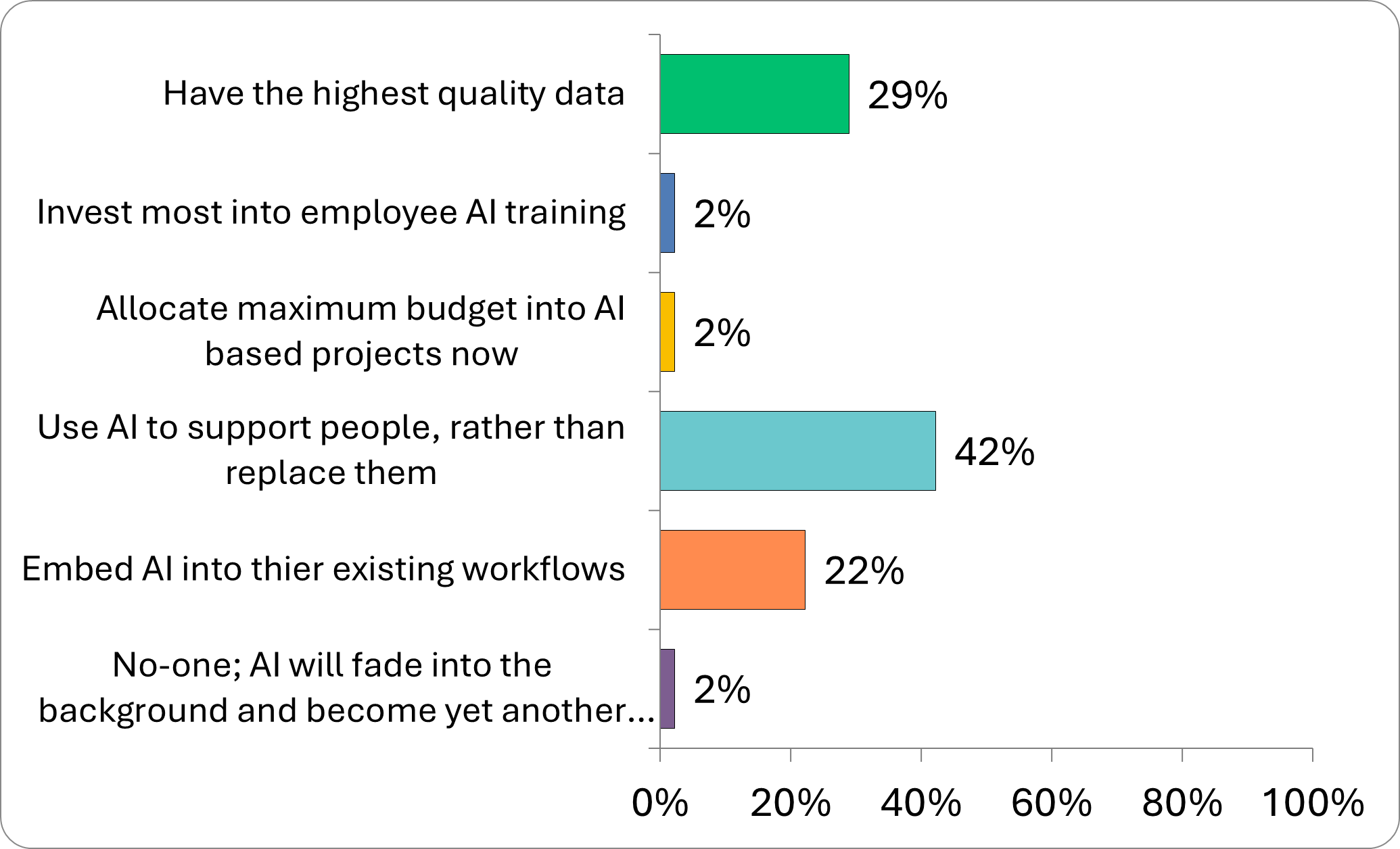
At our Tech & AI Connect event in July, we asked our audience to tell us which retailers will get the most value from AI in two years’ time.
Second to those who ‘Use AI to support people, rather than replace them’ (which is fantastic!), was those who ‘Have the highest quality data.’
Retailers are clearly aware of the role data quality will play.
Barley Laing, the UK Managing Director at Melissa, emphasises the importance of this, particularly around customer data.
He says, ‘Retailers need to recognise that without access to accurate data on customers AI won’t deliver value, in fact quite the opposite.’
‘It could lead to AI induced ‘hallucinations’ which delivers gibberish, or worse, biased and inaccurate outcomes.’
“A good starting point to acquire accurate customer contact data is to use an address lookup or autocomplete tool that delivers a properly formatted correct address when the user starts to input theirs.’
“Similar technology can be used to deliver the first point of contact verification across email and phone, so these vital contact datasets can also be verified in real-time.’
The same applies to product data, particularly as AI becomes a bigger part of how shoppers search for products.
Beth Porter, Senior Onboarding Performance Manager at Shoptimised says, ‘In eCommerce, retailers see the most transformative impact by getting “AI-ready” specifically through optimising product feed quality and structuring clean data.’
‘Google states 75% of shoppers use AI Mode and Gemini for conversational product searches; the success relies on deep context from product feeds.’
‘Features like AI Max leverage text across websites, landing pages, and existing assets to generate tailored, relevant ads in real time.’
Beth reflects on how retailers are looking at ways ‘to efficiently populate the new conversational attributes in a product feed.’
‘Specifically for AI. Some of the key attributes are Related Products, Question and Answer, and Popularity Rank. All of these elements are utilised to send more efficient signals to Gemini and other LLMs.’
Whether it is customer or product information, data quality is emerging as one of the foundations for getting more from AI.
Product discovery and merchandising are becoming more intelligent
Product discovery is one area where the impact is becoming increasingly visible.
Nikhita Hyett, General Manager EMEA at Signifyd starts by saying ‘AI won’t just change how people shop, it’ll transform how retailers optimise every stage of the online customer journey.’
She then says ‘From improving product discovery and search to delivering more personalised recommendations, dynamic pricing and better merchandising decisions, AI is helping retailers create more relevant shopping experiences that improve conversion and drive revenue growth.’
This is also reflected in what retailers are telling us at IMRG.
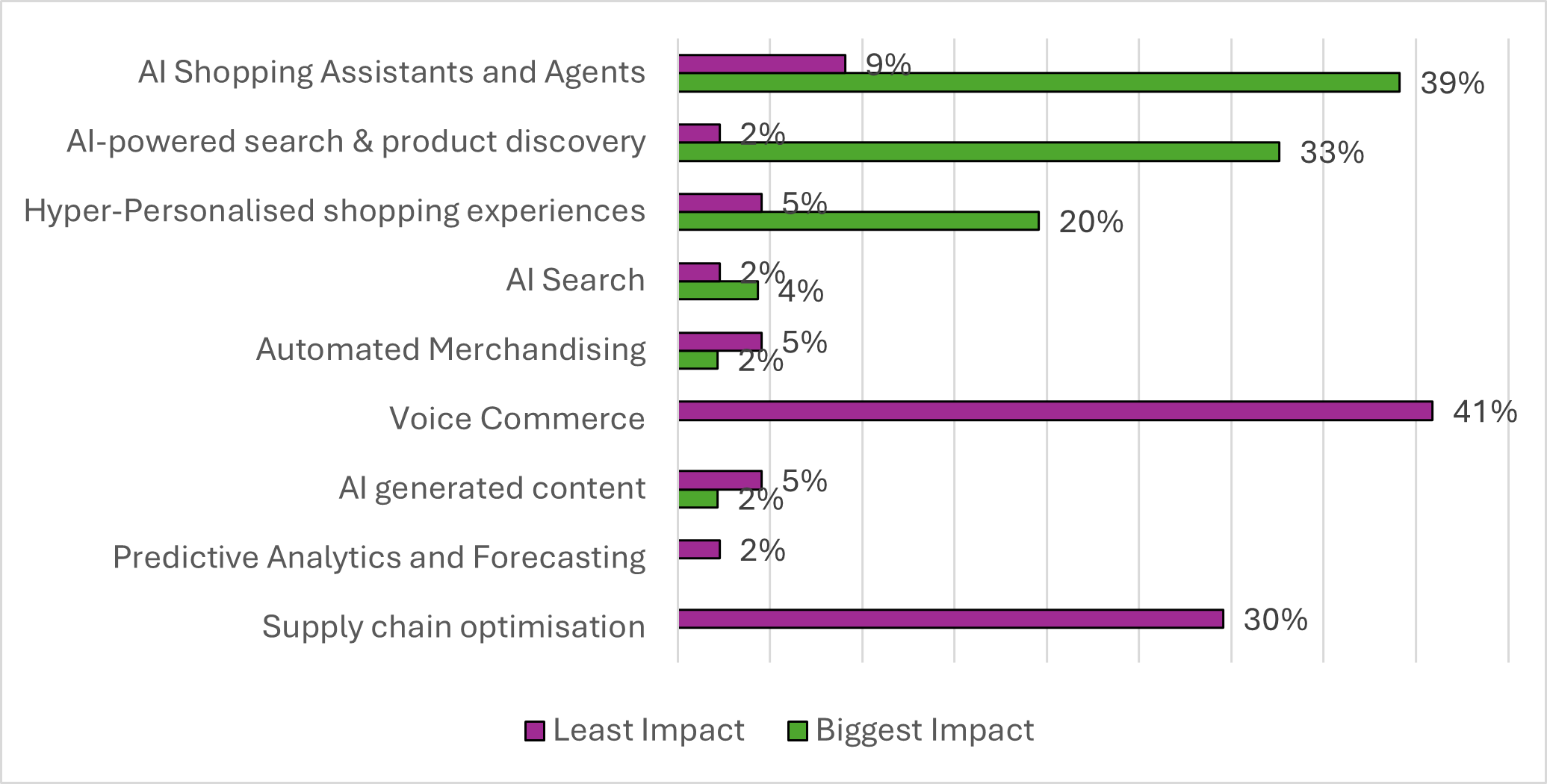
At our Tech & AI event, our community said some of the developments likely to have the biggest impact on eCommerce over the next two years are AI shopping assistants and agents, AI-powered search and product discovery, and hyper-personalised shopping experiences.
Source: IMRG’s retailer survey at Tech & AI Connect 2026
Recommendations and upselling are already providing examples of how this can translate into measurable results.
Jessica Buckly, Technology Partner Consultant at Awin explains the value of AI in upselling, revealing:
‘This sophisticated technology allows advertisers to present tailored upsell opportunities and product recommendations at key touchpoints throughout the customer journey.’
‘A market-leading global Home & Garden retailer implemented AI-powered product recommendations by introducing AI-generated product bundles at checkout.’
‘By using AI to surface additional purchase opportunities at checkout, the retailer capitalised on a high-intent moment in the customer journey, driving basket growth and delivering a 26% uplift in items per transaction, alongside an 8.8% post-impression increase in AOV.’
The opportunity is predictive, not just generative
While generative AI has received much of the attention, predictive applications could have a more direct impact on commercial decisions.
Dan Bond, VP of Marketing at RevLifter echoes how ‘Most of the noise around AI in retail is generative: chatbots, content, recommendations.’
Though, he says, ‘The more valuable shift is predictive.’
‘Retailers seeing the biggest impact aren’t using AI to talk to shoppers, they’re using it to determine who needs persuading and who doesn’t.’
Dan notes how ‘That distinction matters for margin.’
‘Blanket personalisation still means blanket discounting under a smarter label. The retailers pulling ahead are proving impact with control groups, not just claiming it.’
‘Incrementality, not automation for its own sake, is where AI earns its keep in eCommerce,’ says Dan.
For retailers, this puts greater emphasis on measuring whether AI is creating genuinely incremental value.
AI is taking repetitive work out of ecommerce operations
The impact of AI is not limited to the customer-facing journey. It is also helping ecommerce teams reduce manual and repetitive work.
Kevin Steward, UK Country Head, at Base.com says ‘The retailers seeing the greatest impact from AI are using it to solve every day operational challenges.’
‘At Base.com, we see merchants using AI to create richer product descriptions, translate listings for international markets and prepare catalogue content for multiple marketplaces, significantly reducing the time it takes to launch new products.’
Kevin reveals how ‘Fashion and homeware retailers in particular are using AI to manage large catalogues more efficiently while maintaining consistency across channels.’
‘When AI is combined with automation, it removes repetitive tasks, speeds up expansion and gives ecommerce teams more time to focus on growth and customer experience.’
This is another way retailers can assess AI ROI: not just through conversion, but through the time and resource it can save ecommerce teams.
Some of AI’s biggest opportunities are after checkout
AI is also finding a role beyond conversion, particularly across fulfilment, returns and the wider post-purchase experience.
Industry expert fulfilmentcrowd share that ‘A lot of the conversation around AI focuses on conversion, but it also has great value in the post-purchase experience.’
‘AI is increasingly helping retailers anticipate issues, automate customer updates, streamline returns and surface operational data in an instant, something we’ve seen great success with for our own customers.’
‘Its impact varies by sector; fashion retailers, for example, can use AI to identify returns trends and sizing issues. As AI continues to mature, its value will balance further between driving sales and helping retailers deliver a more consistent customer experience after the purchase has been made,’ says fulfilmentcrowd.
Exploring specifically how AI can transform returns is Liselotte Reijrink, Sales Director UK & EU at ReBound Returns.
Liselotte says, ‘The data gathered from returns and AI-powered chatbots can improve products, optimise supply chains, and power predictive tools to help customers make better purchasing decisions, ultimately reducing the total number of returns.’
‘AI can also flag suspicious behaviour to prevent returns fraud. By optimising delivery and returns routes using AI, retailers can further reduce costs and improve sustainability, moving towards the end goal of fewer and more efficient returns,’ reveals Liselotte.
Delivery is another area where AI has the potential to influence both cost and customer experience.
Gavin Murphy, CMO at Scurri makes a very good point: ‘Delivery remains one of the largest controllable costs in eCommerce, making it an ideal target for AI.’
‘By analysing carrier performance, pricing, capacity and delivery outcomes in real time, AI can recommend or even automate the most efficient fulfilment decisions for every order.’
Gavin notes that ‘As retailers become more comfortable with autonomous decision-making, AI will increasingly optimise the economics of delivery as well as the customer experience, delivering tangible cost savings and ROI.’
Together, these examples show why the post-purchase journey is becoming an important area to watch for AI impact.
From AI assistance to autonomous eCommerce
The next stage could see AI move from supporting individual tasks to playing a more active role in ongoing eCommerce decisions.
Industry expert Fullstory expands upon this, revealing how ‘The retailers seeing the greatest impact are those moving AI from one-off analysis toward a self-improving loop.’
‘Pizza Hut is a compelling example. After using AI to turn behavioural data into a product-affinity matrix in 15 minutes — down from one to two weeks — the team’s real ambition is agentic: behavioural data flows into a single layer, an AI agent designs and launches the test, and results feed straight back to sharpen the next cycle, all under human guardrails.’
“AI’s real impact comes from shifting from manual reporting to autonomous, self-improving execution loops,” said Claire Fang, Chief Product and Technology Officer at Fullstory.
This points towards AI becoming part of a continuous cycle of testing, learning and optimisation, rather than being used for one-off tasks.
Agentic commerce puts trust in the spotlight
As AI takes a more active role in retail operations, it could also play a bigger role in how consumers decide what and where to buy.
Nikhita Hyett, General Manager EMEA at Signifyd shares that ‘As agentic commerce takes hold, with AI influencing purchases before a customer ever reaches a retailer’s website, trust will become an even greater competitive advantage.’
‘Retailers that combine intelligent automation with accurate data and seamless customer experiences, including at the point of payment where trust matters most, can capture AI-driven demand and build lasting customer loyalty.’
This means retailers could increasingly encounter AI on both sides of the transaction: within their own operations and in the way that consumers discover and select products.
So, where is AI having the greatest impact?
There is no single area where AI is delivering all of the value. Across these examples, its impact can be seen in revenue, through discovery, recommendations and conversion; margin, through smarter interventions and fulfilment decisions; efficiency, through automation; and customer experience, particularly across checkout and post-purchase.
AI applications are becoming more sophisticated, moving from generation towards prediction, optimisation and increasingly autonomous decision-making. But the greatest value is likely to come from applying AI to clear commercial and operational challenges, supported by strong data, measurement and customer trust.
If you’d like to learn more about AI and how to use it to aid online growth, register for IMRG’s flagship event of the year: Growth Summit 2026!
Published 14/08/2026
