

By Ellie-Rose Davies, Content Manager at IMRG
In this blog we look at eCommerce in H2, sharing what’s happened throughout the year so far and what’s to come next, with predictions and growth strategies from industry experts.
Inside this blog:
- IMRG’s H1 overview (thus far)
- Reacting to changing demand
- Preparing for AI
- Understanding your customers
- Reducing checkout friction
- Improving fulfilment and delivery
IMRG’s H1 overview (thus far)
The first half of 2026 has been a mixed for UK online retail. While growth was more subdued between February and April, the market is now in its fifth consecutive week of year-on-year growth (as of w/c 14th June), according to IMRG’s Online Retail Index, derived from over £30bn of UK online retail spend. This growth likely owes to the late-May heatwave, as well as welcoming the start of the FIFA World Cup.
Though now with sustained hot weather in June, can we expect the end of H1 to end on a high, or as Andy noted in our new podcast episode*, is the online sector better to see fluctuations in weather to drive consumer demand?
*IMRG’s podcast episode: ‘IMRG Takes On… The British Weather’
When reviewing H1 events, it’s important to remember that both Easter and Mother’s Day fell on different dates compared with 2025, creating expected peaks and troughs in retailers’ weekly data. Average basket value has remained around the £130 mark throughout 2026, but since Mother’s Day in March, it has tracked above 2025 levels, at around £140.
At a category level, Clothing continues to face challenging trading conditions, although Footwear is now in its twelve consecutive week of year-on-year growth, as of w/c 14th June 2026. Seasonal events also drove strong performance, with Father’s Day boosting Fragrance (+54.8% YoY) and Menswear (+6.3% YoY), while gifting performed well across both Mother’s Day and Father’s Day.
With H2 fast approaching, we asked industry experts for their outlook on the trends and strategies set to shape the remainder of 2026.
Reacting to changing demand
The first half of the year has shown just how quickly trading conditions can change. From shifting seasonal events to weather patterns and the World Cup, retailers have needed to respond to changing demand rather than rely on historical trends. Looking ahead, that flexibility is likely to remain just as important.
As noted by Bradley Hall, Performance Director, Shoptimised, ‘H2 will be shaped less by what happened last year and more by how retailers react to what is different this year.’
‘The World Cup could shift buying behaviour and peak trading times, while geopolitical uncertainty and delayed holiday bookings may mean fewer people are in the UK shopping during key periods.’
Bradley argues that ‘The biggest opportunity is to stay flexible. Move budget around based on where demand actually is, not where it was last year.’
Though ‘historical data still matters, it should be used as a guide alongside what is happening in the market right now.’
Rethinking promotions
IMRG Online Index data shows the percentage of products that are being sold with some kind of discount against them, this could be a sitewide discount or some kind of code that activates a percentage off the sale.
The data shows that a considerably high number of products are sold with a discount – typically around 71-72%. Though, since Q4 2025 and during Q1 2026 we have seen the rate decline ever so slightly, to just below 70%.
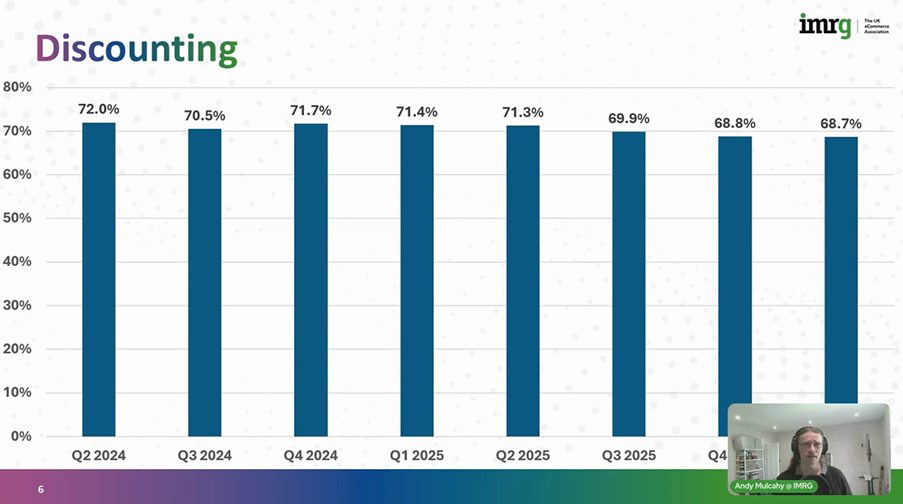
Source: IMRG’s Online Retail Index, presented on The IMRG Show #279
Retailers may be starting to see the value of using more targeted and creative promotions, rather than simply offering bigger discounts.
Speaking on this is Dan Bond, VP of Marketing, RevLifter who shares, ‘H2 performance will largely be shaped by how well retailers understand their own audiences.’
‘The summer months offer a useful window to build that picture. Which visitors convert without any intervention? Which ones respond to a specific type of offer? Which ones are just browsing?’
Dan notes that this ‘kind of insight changes how you approach peak season, shifting the focus from volume of promotions to relevance of promotions.’
‘Margin pressure is likely to be a defining theme in H2, and retailers who address that proactively rather than reactively will be better placed when Q4 demand picks up,’ says Dan.
Similarly, expert Talon.One says, ‘Promotions, done well, are not a margin drain. They are a relationship-building mechanism.’
‘The opportunity heading into H2 is clear. Retailers that continue to default to simple percentage-off mechanics are leaving brand-building potential on the table, especially as gamified formats gain ground fast.’
Talon.One tell retailers to ‘Stop treating discounting as a default and start treating it as a design decision. Not all discounts are equal.’
Their research found that ‘a ‘second pair 50% off’ offer scored more than twice as highly as a flat ‘15% off’ in consumer testing. The reason is engagement: the structured mechanic keeps the customer shopping, increases basket size and preserves the full-price anchor on the first item.’
Promotions are only one piece of the puzzle, however. As AI continues to reshape how consumers discover and evaluate products, retailers are also being challenged to rethink the product experience itself.
Preparing for AI
AI is rapidly changing how shoppers discover, compare and purchase products. As eCommerce becomes increasingly AI-assisted, experts agree that success will depend on the quality of product data, relevance of content and a clear focus on the customer experience.
Alexander Otto, Head of Corporate Relations at Tradebyte highlights how AI is becoming a ‘forcing function for focus.’
‘In a tougher market, AI is exposing which activities genuinely create value and which simply create noise. The biggest opportunity in H2 isn’t just automation – it’s relevance.’
Alexander argues that retailers who that use AI to ‘prioritise the areas that most directly influence discovery, conversion and retention, rather than spreading effort thinly across incremental optimisation,’ will be best placed for Peak 2026.
‘This becomes even more important as commerce moves towards agent-led discovery, with platforms such as Zalando predicting that up to 50% of traffic could come via AI agents by 2030.’
‘In that context, structured, machine-readable product data and clear commercial signals will be essential not just for efficiency, but for visibility itself.’
Also, as more shoppers use AI-powered tools to discover products, the quality of product data is becoming a competitive advantage.
Justin Thomas, VP Sales, EMEA North at Akeneo says that ‘H2 performance will increasingly depend on whether retailers can adapt to AI-mediated commerce journeys.’
‘Consumers are shifting from keyword search to intent-driven discovery through AI assistants, marketplaces and social platforms, which changes how products are surfaced and evaluated.
For Justin, ‘the biggest growth opportunity is no longer simply driving more traffic, but ensuring product experiences are rich, accurate and contextual enough to perform across every AI-powered touchpoint.’
‘Peak trading winners will be retailers that combine operational agility with high quality product data governance, enabling them to personalise faster, launch products quicker and remain visible in increasingly automated buying journeys.’
Understanding your customers
Technology can help retailers become more efficient, but it doesn’t replace a clear understanding of customer needs. As economic pressures continue, ensuring shoppers can quickly find the information they need and understand the value of a purchase remains essential.
Garret Cunningham, VP of CX, at Columbus Global reveals, ‘Whether users are being directly impacted right now or not, the growing concern around the use of AI and its potential to affect employment is also likely to impact users spending ability.’
‘As retailers we often look at the potential benefits we can bring to customers to improve their experience using AI, we forget that on the other side there are jobs at risk as a result.’
Garret exclaims, ‘In order for retailers to turn this trend around we believe the key is to get closer to consumers and understand their needs, what is driving their decisions and make sure that everything we do focuses on addressing them directly.’
‘Don’t rely on users figuring things out themselves, finding the answers or working out the benefits you bring themselves. We need to ensure the key information is front and centre for the user.’
Retailers can run ‘regular surveys with customers post purchase, as well as analysing feedback in reviews to gather qualitative data on what users loved about their purchase and how it improved their lives.’
‘Using this feedback and feeding it into the website content, product descriptions and making it part of the value proposition is a great way of improving the customer experience and increasing the conversion rate,’ says Garret.
Reducing checkout friction
As consumers continue to spend more cautiously, every stage of the purchase journey matters. Experts agreed that reducing friction at checkout, while preparing for increasingly AI-assisted shopping journeys, will be key to improving conversion in H2.
Kevin Griffin, VP Growth at PXP shares what could be a hard reality: ‘Growth in online retail for the rest of 2026 will be hard to find.’
‘Consumer confidence is fragile, and shoppers are spending with more scrutiny.’
Kevin believes ‘The retailers who outperform will do it by holding onto more of the customers they already have.’
‘Every point of friction at checkout is a missed sale, including a missing payment option. A shopper who can’t pay the way they want, or needs flexibility beyond a single upfront payment, doesn’t wait around. They go somewhere that was better prepared.’
Kevin’s point is echoed by Signifyd, who believes the checkout experience will become even more important as AI-assisted shopping continues to evolve.
Nikhita Hyett, General Manager EMEA at Signifyd shares, ‘What we predicted at the start of the year has started to play out.’
‘We’ve seen continuing momentum behind AI-assisted shopping in H1, especially when it comes to discovery, price comparison and repeat purchases, with payment players like Mastercard already building infrastructure to support it at scale.’
‘Looking ahead to H2, retailers have a real opportunity to make shopping easier, faster and more trusted, regardless of whether the customer is human or AI-assisted,’ says Nikhita.
‘The retailers best prepped for the future of eCommerce will be those reducing friction at checkout, strengthening fraud prevention and making it easier for all kinds of shoppers to source and purchase their products.’
Improving fulfilment and delivery
For many retailers, the customer experience doesn’t end at checkout. As Peak approaches, contributors highlighted the importance of getting the operational fundamentals right, from delivery and returns through to proactive communication, to build trust and encourage repeat purchases.
Expert fulfilmentcrowd argues, ‘H2 performance will – as always – be shaped by how confidently retailers can manage rising expectations in a complex trading environment.’
‘As peak approaches, the opportunities for brands lie in the foundations: stock visibility, delivery transparency, returns and proactive customer support.’
‘Retailers that bring all this together through connected systems can be far better positioned to react quickly to demand shifts and consumer requirements.’
‘We expect the strongest performers to focus less on aggressive, short-term tactics, and more on getting the operational foundations right as quickly as possible before the peak season arrives. In a cautious market, reliability is key.’
‘Scurri believes that retailers will be using fulfilment and delivery as a competitive differentiator to help drive repeat purchases.
Rory O’Connor, Founder and CEO at Scurri says, ‘H2 will be shaped by retailers’ ability to turn fulfilment and delivery into competitive advantage rather than greater cost.’
‘Consumers increasingly expect faster, more flexible and more transparent delivery experiences, especially during peak, while AI-driven shopping journeys are compressing the time between discovery and purchase.’
‘Retailers that succeed will be those that can adapt delivery propositions dynamically, communicate proactively throughout the post-purchase journey and maintain resilience during periods of demand volatility.’
‘Peak performance for many will depend on converting trust into repeat purchasing through consistently strong delivery experiences.’
In summary
While H2 will bring its own challenges (and opportunities!), several common themes emerged from our contributors: staying agile, understanding customers, preparing for AI-driven commerce and delivering seamless experiences from product discovery through to fulfilment. Together, these provide a useful framework for retailers preparing for the second half of 2026.
Want to read more? Here are some recently published blogs that might take your interest:
The importance of moving retail from linear to circular supply chains – IMRG
IOSS and EU customs changes: Five action points retailers should consider before July 1st – IMRG
Product Discovery: Why reviews and trust matter more than ever – IMRG
Unlocking new opportunities: OpenAI’s self-serve ChatGPT advertising – IMRG
The experience economy is coming for every brand touchpoint – IMRG
Published 26/06/2026
