
10 Mar 2025
Trends within fashion and beauty eCommerce

By Ellie-Rose Davies, Content Executive at IMRG
Throughout 2024, Beauty emerged as a top-performing subcategory tracked by IMRG, while Clothing struggled to gain momentum. These trends have persisted into early 2025.
In this blog, we'll explore the latest trends in these two sectors and share practical growth strategies. Read on to discover what fashion and beauty retailers can learn from each other, and how those managing both categories can do so effectively.
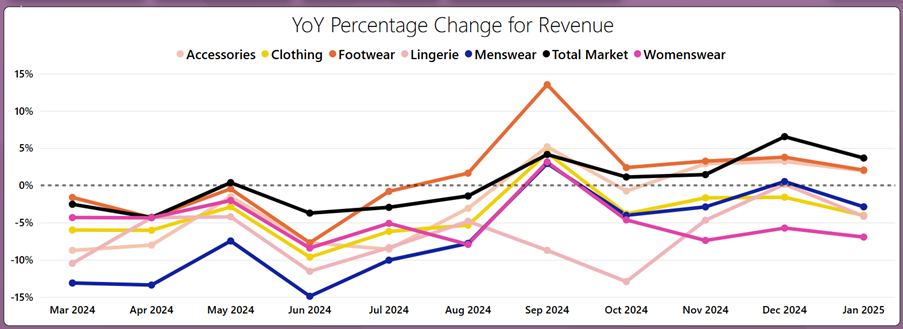 The Clothing sector continues to struggle to gain momentum, with all relevant subcategories experiencing declines in Year-on-Year revenue growth, according to IMRGs Online Retail Index. Footwear stands as the exception, showing growth in a few months of 2024 and maintaining six consecutive months of growth since August 2024. The category saw a particularly strong peak in September 2024.
Overall, the Clothing sector consistently underperforms compared to the total online market.
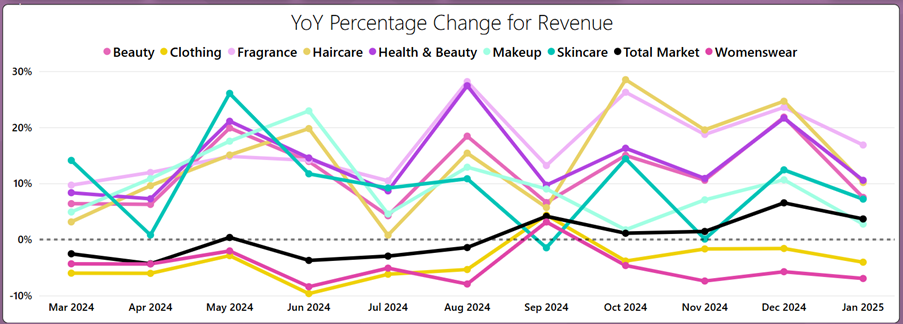 In stark contrast to Clothing, the Beauty sector is performing exceptionally well according to IMRGs Online Retail Index. Particularly since 2023, Beauty has ridden above the wave of total online market performance. In 2025 thus far, Fragrance and Haircare have been the top performing subcategories of Health & Beauty, but Beauty has also seen substantial growth.
IMRG index data: Fashion and beauty commerce
Fashion trends
The Clothing sector continues to struggle to gain momentum, with all relevant subcategories experiencing declines in Year-on-Year revenue growth, according to IMRGs Online Retail Index. Footwear stands as the exception, showing growth in a few months of 2024 and maintaining six consecutive months of growth since August 2024. The category saw a particularly strong peak in September 2024.
Overall, the Clothing sector consistently underperforms compared to the total online market.
Beauty trends
In stark contrast to Clothing, the Beauty sector is performing exceptionally well according to IMRGs Online Retail Index. Particularly since 2023, Beauty has ridden above the wave of total online market performance. In 2025 thus far, Fragrance and Haircare have been the top performing subcategories of Health & Beauty, but Beauty has also seen substantial growth.
