
25 Feb 2026
Fashion and Beauty eCommerce trends for 2026

By Ellie-Rose Davies, Content Manager at IMRG
In this blog we explore core fashion and beauty trends that will help you shape your 2026 strategy.
The blog covers:
- IMRG Fashion & Beauty insights
- Expert metric analysis
- Opportunities for Fashion & Beauty retailers
- Customer insight & strategic agility
- Pricing discipline & stock visibility
- AI & experience-led growth
- Beauty & wellness: precision, personalisation and packaging
- Fashion: localisation and operational agility
- Delivery performance and category divergence
IMRG Fashion & Beauty insights
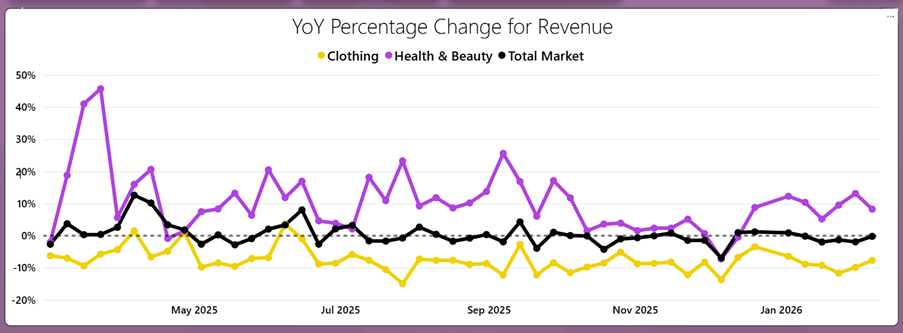
IMRGs Online Retail Index which represents over £30bn in online spend shows that while Health & Beauty retailers consistently perform above the total market, Clothing consistently underperforms (See chart below).
Source: IMRGs Online Retail Index
Clothing retailers experienced growth during the lockdown period, but since 2023 have seen declines. Looking at 2025 data, Clothing consistently underperformed compared to the total market (see chart below).
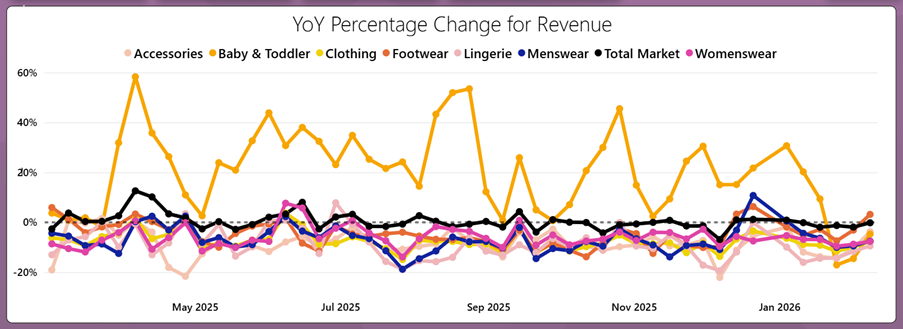
Source: IMRGs Online Retail Index
The one standout sub-category of Clothing is Baby & Toddler, with growth higher than +50% year-on-year in some weeks. In comparison, all Health & Beauty sub-categories are performing well (see chart below).
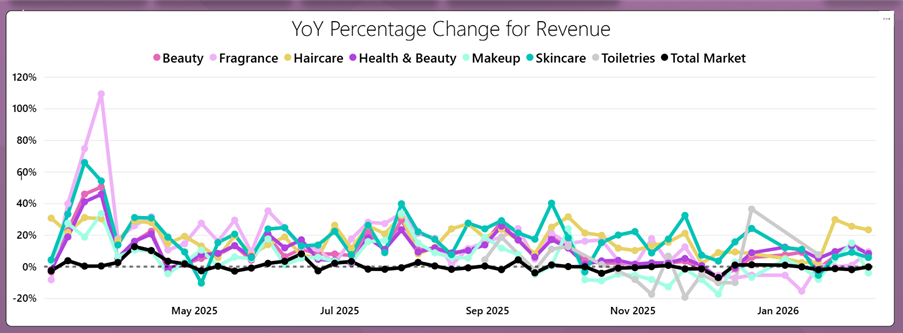
Source: IMRGs Online Retail Index
Haircare and skincare are top performers, with weekly growth above +20% year-on-year in most weeks. Haircare has seen growth as high as 30%+ year-on-year in January 2026. Beauty and skincare have also had a strong start to 2026. The big spike for Fragrance in March was due to Mothers Day falling in a different week in 2025 versus 2024. Fragrance performance has slipped away slightly so far in 2026. IMRGs 2026 forecast for Fashion and Beauty in the context of other categories: Sports and outdoors: +8% Health & Beauty: +5% Gifts: +2% Home & Garden: +1% Electricals: 0% Clothing: -4% YoYExpert metric analysis
We spoke with our community of industry experts who shared further insights on fashion and beauty online performance. Lewis Husbands, Client Success Specialist at ShoppingIQ said, We've seen premium/luxury conversion rates fall YoY, for some brands hitting 4% in Jan/Feb 2025 to around 3% in 2026. This has not been helped by rising CPCs. He noted how Mid-Tier brands' conversion rate remained relatively flat for many clients around 1%, but they required increased spend to get the same results. Health products conversion rates have fared better YoY with some seeing modest growth in sales and revenue. Lewis explained, This combination of rising CPCs and consumers shifting to lower order value means margins are being squeezed. We predict that consumers will also take longer to convert on items over £50, taking more time, more clicks and more spend. We also spoke with Nikhita Hyett, General Manager EMEA at Signifyd who revealed that according to their data Fashion and beauty are entering 2026 on very different trajectories. Consumers are trimming their fashion baskets at checkout with a 3% drop in average order value. Beauty, by contrast, has seen AOV lift by 9% as consumers opt for little luxuries, contributing to 6% year on year sales growth, although order volumes are softening amid online inflation of around 5%. Both verticals now face increasing margin pressure, meaning retailers must protect profitability without introducing friction for genuine customers, said Nikhita.Opportunities for Fashion & Beauty retailers
Making agility a core strategy
As performance pressures continue across both categories, agility and operational discipline are emerging as defining traits of the strongest performers. From pricing and stock visibility to AI-driven experience, retailers are refining how they respond to real-time demand.Customer insight & strategic agility
Aaron Stephens, VP of Global Retail at PXP shared that, The retailers outperforming today are those who understand who their actual customer is, not who they assumed them to be, and are shaping product, pricing, and messaging accordingly. Agility remains critical, emphasised Aaron. Brands are winning by responding quickly to unmet needs and using customer insight to guide product evolution. At the same time, operational discipline, including clearer refund strategies and thoughtful pricing personalisation, can protect revenue without eroding trust. Aaron said, The leaders of 2026 will combine customer intimacy with smart, data‘driven execution.Pricing discipline & stock visibility
Hemang Nathwani, CEO and Co-Founder at Price Trakker echoed the value of being agile, specifically around pricing and stock visibility.He shared, One of the biggest shifts we are seeing in fashion and beauty is the move toward more smarter pricing and stock discipline.
Retailers that are performing well are using real-time competitor and availability data to avoid over-discounting and protect margin. In beauty, strong growth continues to come from brands that focus on trust, consistency, and availability rather than aggressive promotions. Fashion retailers are also becoming more selective in range and launch strategies, supported by automation and data-led planning. Strong performers are those combining pricing insight, stock visibility, and faster execution rather than relying on traditional seasonal discount cycles, revealed Hemang.