
09 Oct 2025
Top tips to aid product discovery in eCommerce

By Ellie-Rose Davies, Content Executive at IMRG
Helping customers find what they didnt know they needed can be as valuable as helping them buy what they came for.
In this blog, we explore how retailers can enhance product discovery, from optimising search and social channels to refining presentation, recommendations, and promotions ” to capture intent and drive conversion.
Read on for insights into how retailers are:
 When a consumer does not know exactly what they want to buy, search is the natural first step.
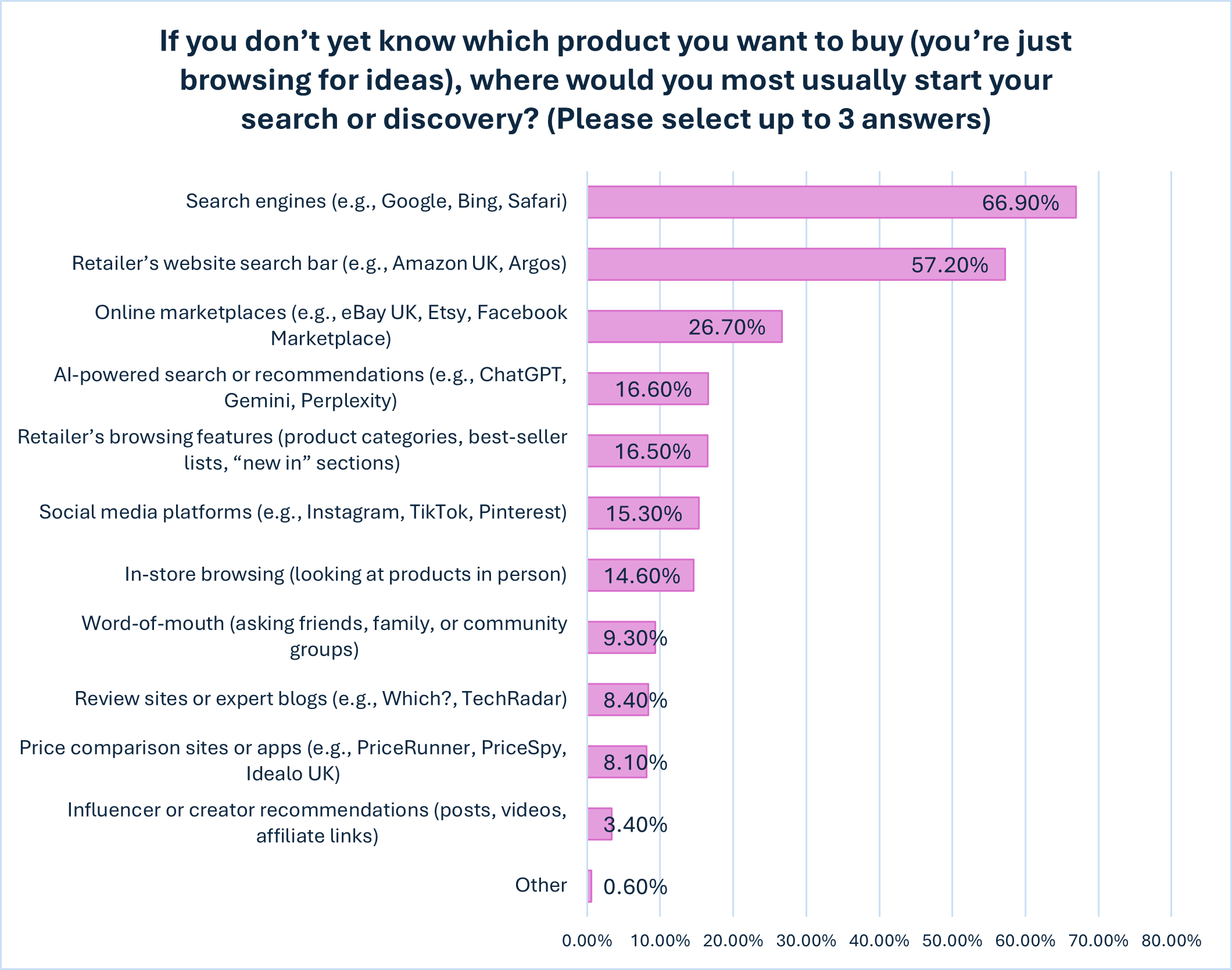
According to our recent research with Feedonomics, the most common starting points for product search are search engines (selected by 66.9% of 1,000 UK respondents), followed by a retailers own website search bar (57.2%), and online marketplaces (26.7%).
Andra Muntean, Senior Marketing Manager EMEA at Athos Commerce shares that Great discovery is about relevance.
Search should handle typos and natural-language queries, recommendations should feel useful, and feeds should be optimised for Google, marketplaces, and AI platforms.
Andra continues, Done well, this reduces bounce and lifts AOV. For example, retailers who tailor cross-sells by category make can make shopping easier, while generic trending products may often feel intrusive.
Andra shares that A common mistake is confusing discovery with distraction. Forcing unrelated items into results breaks trust.'
'The goal should be simple: make it effortless for customers to find what they came for and uncover products they did not know they wanted.
Simon Dyer, Regional Vice President, UK & Nordics at Mirakl shares his tips for retailers looking to improve search and discovery on their site. He says:
Effective product discovery starts with clean, consistent data. When titles and attributes align to a sensible taxonomy, filters and search can guide shoppers quickly to the right options.
Confidence follows with clear imagery, size and compatibility cues, reviews and results that favour items in stock and fast to deliver. Key shopping moments ” Black Friday, back-to-school, holiday gifting ” become curated entry points that surface the most relevant assortment, not detours.
From Alexander Otto, Head of Corporate Relations at Tradebyte provides tips for improving search and discoverability through marketplaces.
Marketplaces have shown to be a top way consumers discover products, especially when they already know what they want to buy.
Alexander says, Over 50% of product searches in Europe start directly on Amazon rather than on a search engine like Google, according to Statista, while third-party sales through online marketplaces are projected to account for around 59% of all global eCommerce by 2027.
This trend is particularly strong in Europe, where marketplaces like Amazon, Zalando, and About You dominate.
A common mistake we see is applying a one-size-fits-all approach. Brands can tailor their strategies to each marketplace platforms unique ranking criteria, ensuring accuracy, engaging imagery, and detailed attributes that build trust and reduce returns.
By blending retail media with performance marketing and platform-specific optimisation, brands can move from being seen to being chosen, ultimately driving both conversion and long-term loyalty, says Alexander.
- Optimising search to capture intent
- Leveraging social to build awareness
- Using presentation and recommendations to drive conversion
- Applying promotions to boost visibility and loyalty
Optimising search to capture intent
When it comes to product discovery, search remains the starting point for most consumers. Whether its a Google query, a website search bar, or a marketplace filter, each touchpoint offers retailers a chance to meet customers with precision and intent.
When a consumer does not know exactly what they want to buy, search is the natural first step.
According to our recent research with Feedonomics, the most common starting points for product search are search engines (selected by 66.9% of 1,000 UK respondents), followed by a retailers own website search bar (57.2%), and online marketplaces (26.7%).
Andra Muntean, Senior Marketing Manager EMEA at Athos Commerce shares that Great discovery is about relevance.
Search should handle typos and natural-language queries, recommendations should feel useful, and feeds should be optimised for Google, marketplaces, and AI platforms.
Andra continues, Done well, this reduces bounce and lifts AOV. For example, retailers who tailor cross-sells by category make can make shopping easier, while generic trending products may often feel intrusive.
Andra shares that A common mistake is confusing discovery with distraction. Forcing unrelated items into results breaks trust.'
'The goal should be simple: make it effortless for customers to find what they came for and uncover products they did not know they wanted.
Simon Dyer, Regional Vice President, UK & Nordics at Mirakl shares his tips for retailers looking to improve search and discovery on their site. He says:
Effective product discovery starts with clean, consistent data. When titles and attributes align to a sensible taxonomy, filters and search can guide shoppers quickly to the right options.
Confidence follows with clear imagery, size and compatibility cues, reviews and results that favour items in stock and fast to deliver. Key shopping moments ” Black Friday, back-to-school, holiday gifting ” become curated entry points that surface the most relevant assortment, not detours.
From Alexander Otto, Head of Corporate Relations at Tradebyte provides tips for improving search and discoverability through marketplaces.
Marketplaces have shown to be a top way consumers discover products, especially when they already know what they want to buy.
Alexander says, Over 50% of product searches in Europe start directly on Amazon rather than on a search engine like Google, according to Statista, while third-party sales through online marketplaces are projected to account for around 59% of all global eCommerce by 2027.
This trend is particularly strong in Europe, where marketplaces like Amazon, Zalando, and About You dominate.
A common mistake we see is applying a one-size-fits-all approach. Brands can tailor their strategies to each marketplace platforms unique ranking criteria, ensuring accuracy, engaging imagery, and detailed attributes that build trust and reduce returns.
By blending retail media with performance marketing and platform-specific optimisation, brands can move from being seen to being chosen, ultimately driving both conversion and long-term loyalty, says Alexander.
