By Ellie-Rose Davies, Content Executive, IMRG
After a difficult year for online retail in 2023, with consistent declines reported for many retailers, industry experts are making their predictions for what is to come this year. This blog outlines some great expectations for 2024, enabling retailers to identify focus points for growth and to be best prepared for what is to come.
IMRGs Forecast for 2024
Each year IMRG release a forecast for the year ahead based on historic data and current insights. This forecast reveals our monthly revenue growth predictions for the total market and individual product categories.
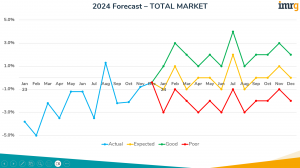
As you can see on the chart, we have revealed what we expect (yellow line) for online retail revenue growth in 2024, as well as a potential good (green line) or bad (red line) outcome. We expect there to be three noticeable moments of year-on-year (YoY) growth throughout the year, where we predict that retailers will be able to build on some of the worse performing months in 2023, such as February and July.
August was particularly positive in 2023, and owing to the tough comparator, we predict a YoY decline for August 2024. While we do expect some declines, most months we predict a growth rate somewhere between +1% YoY and -1% YoY, signalling that we expect little fluctuation in performance from last year.
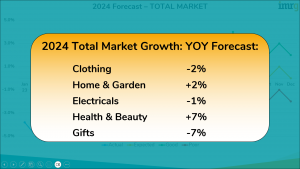
Out of all the product categories tracked in IMRGs Online Retail Index, health & beauty was the top performer in 2023 (+10.4% YoY), and we only expect positive things (+7% YoY) for this category in 2024. The other category we expect will experience some growth is home & garden (+2% YoY).
The two categories that struggled the most throughout 2023 was clothing and gifts and, unfortunately, we expect further declines for these retailers in 2024. We expect a lesser decline for electrical retailers in 2024, of whom performed better than expected in 2023 (-0.6% YoY).
Each week you can see how the industry has performed and benchmark your performance using IMRGs Digital Dashboard.
Four great expectations for 2024:
1. Greater customer-centricity and relevancy
With customer acquisition and retention being a top priority for retailers this year, more retailers will welcome customer-centric selling, which means heightened personalisation and relevant communication.
François Rychlewski, VP of Sales EMEA at
SheerID, exclaims that To stand out from fierce competition, retailers should deliver hyper-personalised, curated shopping experiences - from online shops, third party marketplaces, apps, to stores.
In 2024, we expect to see retailers prioritise collecting high-quality, first-party customer data to serve customers in their moment of need in their shopper journey” through product recommendations, personalised rewards, or targeted messaging, says François.
He continues, Brands offering a seamless, unified omnichannel experience - putting the customer first - will build more long-term loyalty and win in 2024.
However, many UK-based retailers tend to overlook the importance of adapting their communication to their international customers, who may share different preferences and lifestyles. Offering relevant experiences is crucial seen as Alex Bryan, Customer Success Manager at
Loqate, reveals that, One of the standout trends that will dominate in 2024 is the surge in cross-border commerce.
Alex says, Thanks to advancements in technology, logistics, and payment systems, small and large enterprises alike can now tap into a global customer base. Consumers too are more open to cross-border shopping as seen by the phenomenal success of brands like Temu and Shein.
With demand for cross-border selling, Alex urges retailers to ensure they are well equipped to handle not only cross-border logistics but also collecting and managing the complexities of international customer data.
Thinking about how to actualise personalised experiences is Christina Augustine, COO at
Bloomreach. She exclaims, AI has disrupted the retail industry and challenged brands to think about how they communicate with their customers, at scale. This year, we will see retail brands leverage AI to become more customer centric, tailoring their communications at every step of the customer journey.
Retailers are prioritising personalisation now more than ever, and across multiple channels, where Christina gives the examples of product recommendations, predicting returns, and conversational commerce. She suggests for retailers to use AI tools that will support your team in creating impactful customer experiences.
2. Increased customer touchpoints and communication
Seen as customer loyalty is proving more difficult, it has become integral for retailers to increase their customer touchpoints and to go the extra mile with communication.
Retailers are growing their online identity through having engagements on various communication platforms and by speaking to customers at every stage of their purchasing journey, including the important post-purchase stage, to improve customer retention.
Gavin Murphy, CMO at
Scurri, says With the cost of acquiring new customers continuing to rise, tight privacy rules limiting marketing effectiveness, and the depreciation of third-party cookies, in 2024 retailers will need to double down on engaging existing customers to maximise loyalty and generate repeat purchases.
It is worth remembering that customer engagement continues beyond the buy button “ the point at which shoppers are arguably the most engaged during the buying journey, shares Gavin.
He continues, Scurri research shows 81% of shoppers will always open emails from a retailer or brand if they are updating the customer on the status of their order delivery. Post-sales communication can be used to up-sell and cross-sell by highlighting other products within delivery tracking emails, offering additional and valuable insights that take place off the website.
In addition, This communication can be used to start the customer's next buying cycle, enhance customer experience, and dial-up sales and conversion performance.
Retailers can also use indirect customer touchpoints, such as influencer content, to improve brand awareness and loyalty. Robert Davinson, Global Head of Content Marketing at
Awin, notes that there has been a slowdown on social, where new user growth has started to plateau, and ad spend is also expected to flatten out following a huge spike during the pandemic.
One way for brands to insulate themselves from this slowdown on social is to consider partnering with creators on a more direct basis. Robert describes how Influencer marketing spend has shown itself to be more resilient and less prone to sudden fluctuations in cost than paid social. And more enterprise brands are increasingly launching their own large-scale creator affiliate programs recently as they seek to work closer with these influential figures.