
AI and the future of online shopping: Are consumers ready to let AI take the lead?

By Aynsley Peet, Head of Growth at The Pixel
New research from The Pixel, in conjunction with Stripe, explores how consumers are using AI shopping assistants, the tools they prefer and how much they trust AI to influence purchasing decisions.
AI is changing how consumers discover, research and compare products. From ChatGPT and Gemini to AI-powered shopping assistants, new technologies are creating opportunities to make online shopping faster, more personalised and more convenient.
But while consumer adoption is growing, are shoppers ready to let AI take control of their purchasing decisions?
A new online consumer survey conducted by The Pixel in conjunction with Stripe, explored how consumers are using AI to shop, what they trust it to do and what would encourage them to hand over more responsibility.
The findings reveal a growing appetite for AI-assisted product research, but a much more cautious approach when it comes to allowing AI to complete purchases.
1. AI shopping adoption is growing, but awareness doesn't always mean usage
Our survey found that almost two-thirds of respondents (64.77%) have used an AI assistant to research or shop for products at least once.
Of these, 13.70% use AI frequently, while 30.82% use it occasionally and 20.25% have tried it once or twice. However, more than a third (35.23%) are aware of AI shopping assistants but have never used them.
This suggests that AI is becoming an established part of the online research journey, although regular adoption is still developing.
For retailers, the opportunity is to understand how AI is influencing product discovery and ensure their products, content and data are accessible to emerging AI-powered tools.
2. ChatGPT leads the AI shopping landscape
When asked which AI tools they had used, ChatGPT was the clear leader, selected by 55.97% of respondents.
Other tools included:
-
Gemini - 33.46%
-
Copilot - 20.25%
-
Meta AI - 15.17%
-
Claude - 8.22%
-
Grok - 5.38%
-
Perplexity - 4.99%
A further 23.29% selected none.
As consumers become familiar with different AI platforms, retailers need to consider how their brands and products appear across an increasingly diverse discovery landscape. Product information, structured data and relevant content will become increasingly important in helping AI tools understand and recommend products.
3. Product research is the primary use for AI shopping assistants
Consumers are currently using AI primarily to support the research and consideration stages of the buying journey.
The most popular uses were:
-
Product research - 40.80%
-
Comparing products - 31.60%
-
Price comparisons - 28.86%
-
Finding deals - 24.95%
-
Gift ideas - 20.55%
-
Product recommendations - 18.98%
-
Summarising reviews - 18.40%
These results demonstrate that AI is already helping consumers make more informed purchasing decisions.
Rather than immediately replacing traditional search or retailer websites, AI is increasingly being used alongside existing shopping behaviours to narrow down choices, compare options and identify the best products.
For businesses, this creates an opportunity to make product information more comprehensive, accurate and accessible, helping consumers find the answers they need throughout their buying journey.
4. Can consumers trust AI recommendations?
Trust remains a significant consideration.
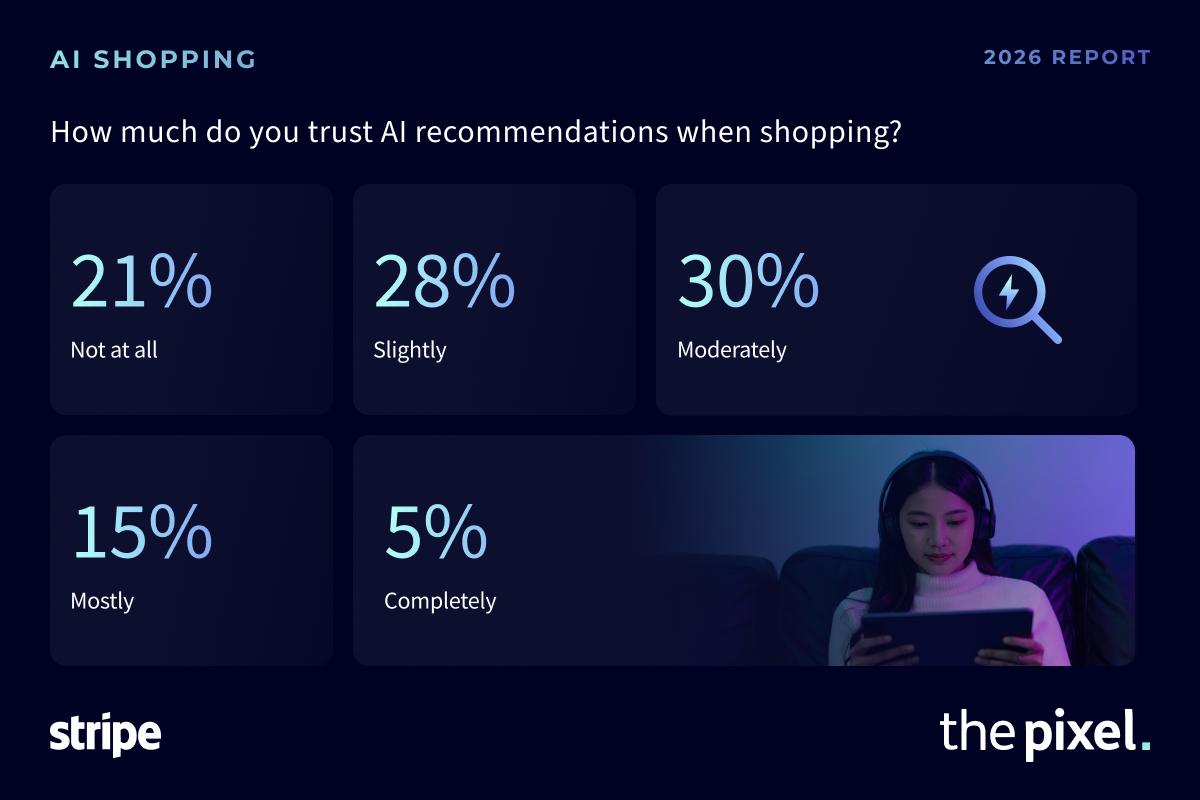
When asked how much they trust AI recommendations when shopping, 30.23% said moderately, 14.87% mostly and just 5.28% completely.
Meanwhile, 28.47% said they trusted AI recommendations slightly, while 21.14% did not trust them at all.
The results suggest that while consumers are willing to use AI for advice and research, many remain cautious about relying on its recommendations.
This presents an important challenge for retailers. Accuracy, transparency, reliable product information and customer reviews will all play a role in building confidence in AI-assisted shopping.
5. From recommendations to purchases: Is agentic commerce ready?
One of the most interesting findings relates to whether consumers have actually purchased products recommended by AI.
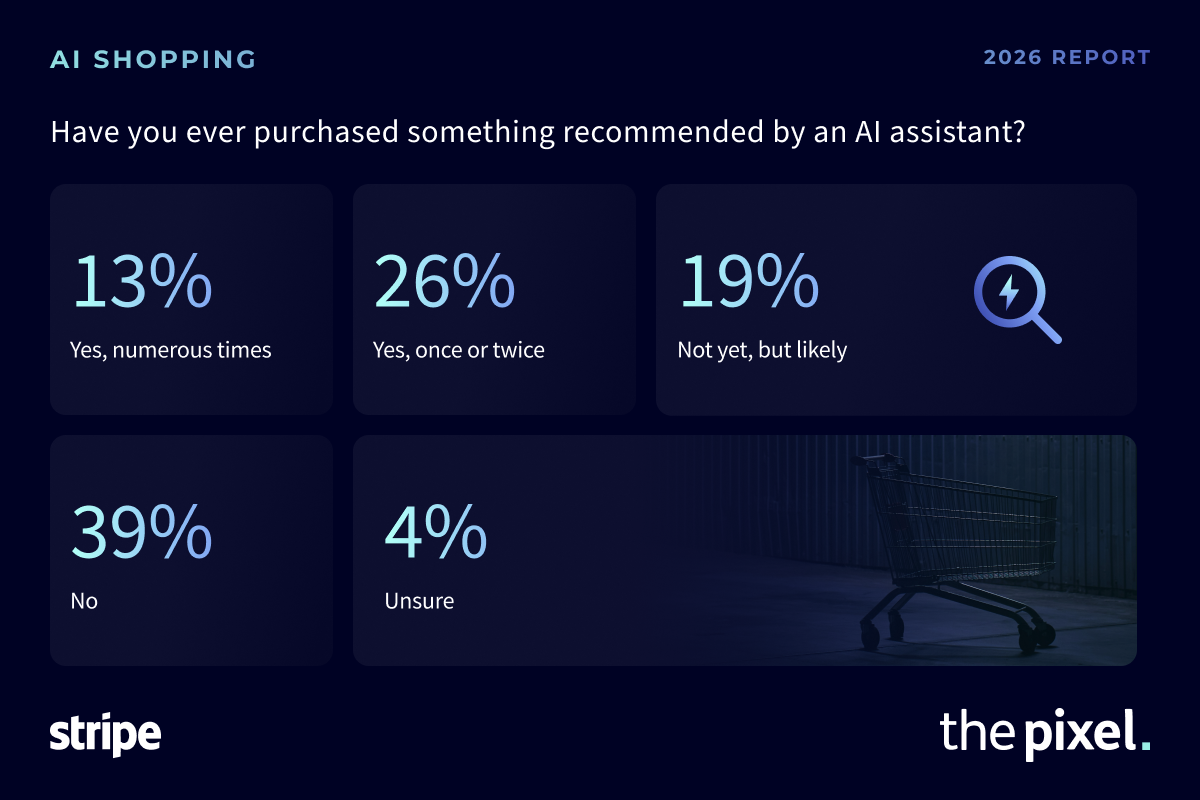
Almost four in ten respondents (38.65%) said they had purchased something recommended by an AI assistant, with 12.82% having done so numerous times and 25.83% once or twice.
A further 19.18% had not yet made an AI-recommended purchase but said they were likely to, while 38.65% said they had not.
However, there is a clear distinction between accepting an AI recommendation and allowing AI to complete a transaction.
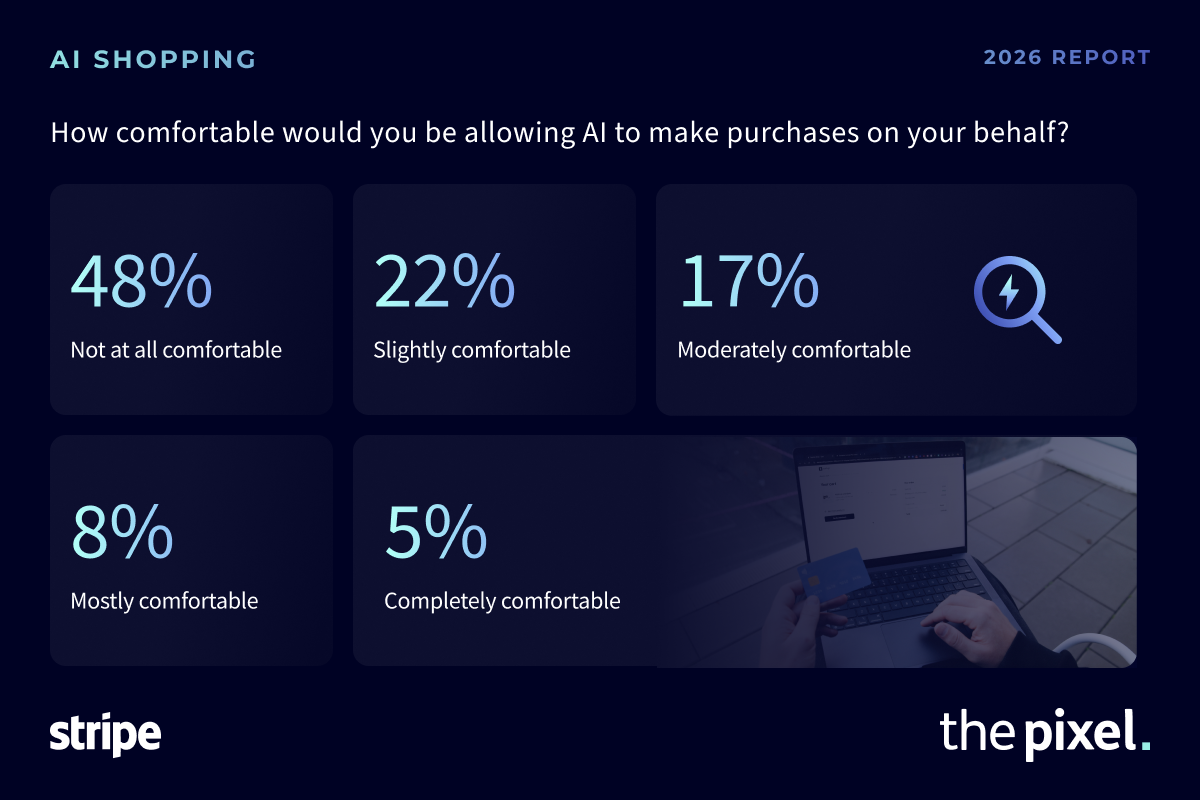
Almost half of respondents (48.14%) said they would be completely uncomfortable allowing AI to make purchases on their behalf. A further 22.11% were only slightly comfortable.
Just 13.01% said they would be mostly or completely comfortable.
This highlights the gap between AI-assisted shopping and agentic commerce, where AI can take action and complete transactions on behalf of consumers.
While the technology is evolving rapidly, consumer confidence and control remain important barriers to wider adoption.
6. What would consumers trust AI to purchase?
When asked under what circumstances they would trust AI to complete a purchase, 40.31% said never.
Among those open to the idea, low-cost items were the most popular category (31.70%), followed by repeat purchases (27.10%) and household essentials (17.42%).
Travel bookings (11.55%), fashion (10.76%) and electronics (8.41%) attracted less interest.
This suggests consumers are more comfortable with AI handling straightforward, familiar or lower-risk transactions than making more considered purchasing decisions.
For retailers, the opportunity may initially lie in using AI to simplify routine purchases, support replenishment and help customers find relevant products, rather than expecting consumers to hand over complete purchasing control.
7. The future: AI alongside traditional shopping
Despite growing interest in AI, consumers are not necessarily looking to replace traditional shopping experiences.
Our survey found:
-
31.80% expect to use AI alongside traditional shopping.
-
23.87% expect to use AI occasionally.
-
8.51% believe AI will become their main shopping assistant.
-
35.81% do not expect to use AI for shopping.
The findings suggest that AI is likely to become another channel within the wider customer journey, rather than an immediate replacement for retailer websites, search engines and established shopping behaviours.
Retailers should therefore focus on creating connected experiences that support customers whether they discover products through traditional search, social media, retailer websites or AI assistants.
8. What would make consumers more comfortable with AI purchases?
For consumers to trust AI with more of the purchasing process, they want greater control, transparency and reassurance.
The most popular features that would encourage consumers to let AI complete a purchase were:
-
Price drop alerts - 28.47%
-
AI asking for approval before checkout - 25.64%
-
Better price comparisons - 22.99%
-
Spending limits - 22.31%
-
Trusted retailers only - 21.43%
-
AI explaining its recommendations - 20.55%
-
Purchase history - 17.61%
-
Clear order summaries - 13.41%
Price monitoring and consumer control are particularly important. Shoppers want AI to help them secure better deals, but they also want the ability to approve transactions and set boundaries.
This reinforces the importance of transparency, trust and clear customer permissions as AI-powered commerce develops.
What does this mean for retailers?
The survey highlights an important distinction: consumers are increasingly comfortable using AI to research, compare and discover products, but remain much more cautious about allowing it to make purchasing decisions.
For retailers, there are several priorities to consider:
1. Get your product data ready for AI. Ensure product information is accurate, structured, comprehensive and accessible to support AI-powered discovery and recommendations.
2. Make product discovery easier. Provide useful content, detailed product descriptions, specifications and customer reviews that help consumers make informed decisions.
3. Build trust and transparency. Ensure product recommendations are relevant, explainable and supported by reliable information.
4. Maintain customer control. Give shoppers clear choices around permissions, spending limits and purchase approval as AI-driven transactions evolve.
5. Prepare for agentic commerce. Understand how emerging AI technologies could influence product discovery, checkout, payments and the wider customer experience.
Conclusion: AI will influence the future of shopping, but trust will determine how far it goes
The findings from The Pixel and Stripe survey demonstrate that AI is already influencing how consumers research products, compare prices and discover new deals.
However, the willingness to use AI as a shopping assistant does not automatically translate into confidence in allowing it to make purchases.
For now, consumers appear to value AI as a tool that supports their decisions rather than one that makes decisions for them.
As AI technology continues to evolve, retailers have an opportunity to build experiences that combine the convenience and intelligence of AI with the trust, transparency and control customers expect.
The next phase of digital commerce will not simply be about what AI can do. It will be about what consumers are comfortable allowing it to do.
Please contact [email protected] if you would like to receive a full copy of the The Future of Online Shopping survey covering payments and online consumer shopping habits.
Published 20/11/2026
